

Pilates Ab Workout (10 CORE EXERCISES WITH VIDEO DEMOS AND A 15-MINUTE ROUTINE)
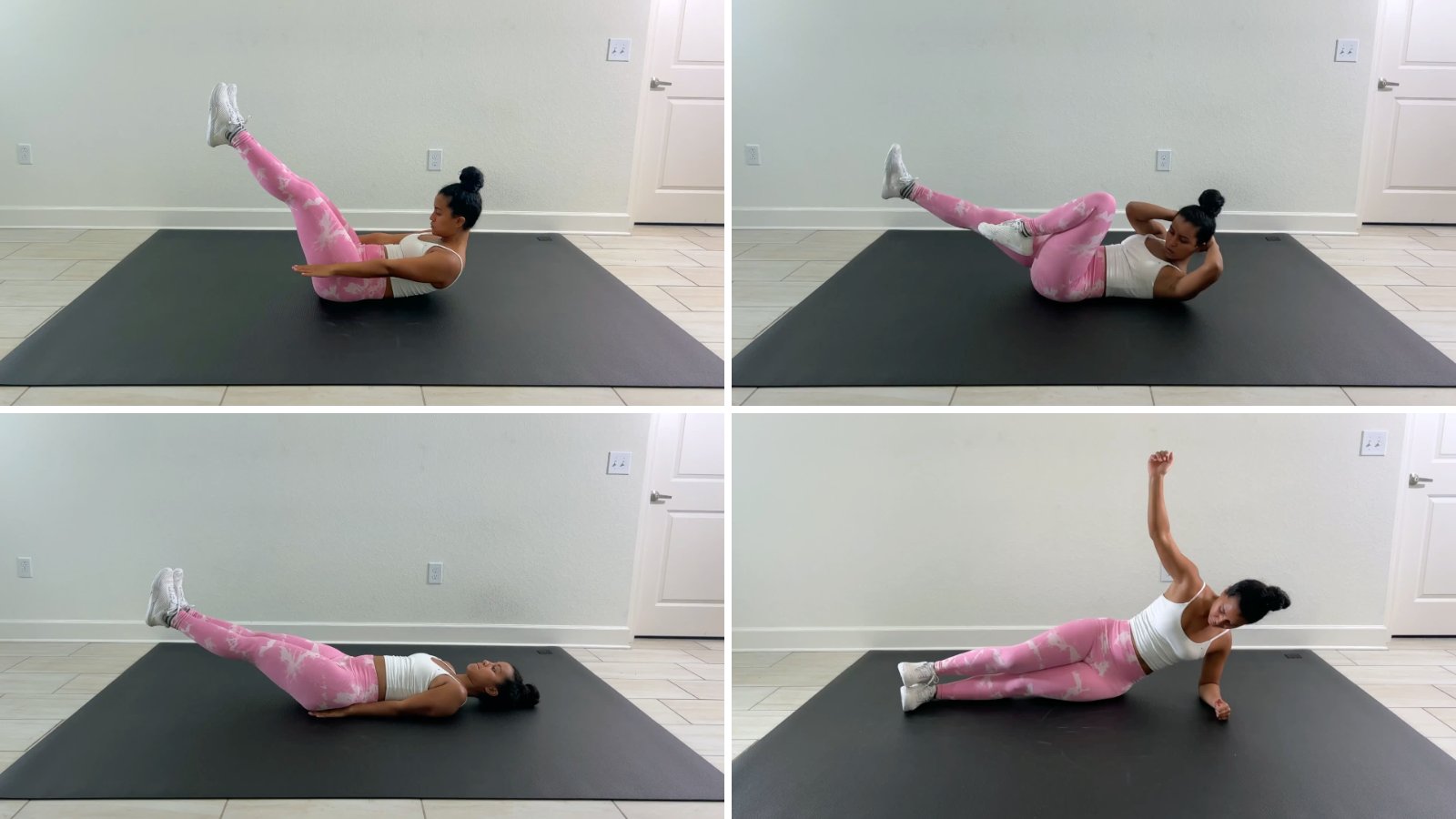
This Pilates ab workout links 10 mat exercises, from the classic hundred to swimming legs, into one routine of about 15 minutes that you can do at home with just a mat. Nine of the 10 moves have a short video demo, and each one comes with step-by-step cues and an easier or harder option. Each move uses controlled movement, and most are done slowly, to train your whole core.
Workout at a glance
- Time: about 15 minutes, including short rests. A shorter beginner version is below.
- Equipment: an exercise mat.
- Level: beginner to intermediate, with easier and harder options.
- What it trains: the front, sides and deep layers of your core, plus your lower back and glutes.
- How often: 2–3 times a week.
In this guide
Your core muscles
- Rectus abdominis: the “six-pack” muscle at the front.
- Obliques: on your sides, for twisting and bending sideways.
- Transverse abdominis: a deep layer that wraps around your middle like a corset.
- Back muscles, pelvic floor and diaphragm: these work with your abs to support your spine.
Will Pilates give you abs or a flat stomach?
Pilates can make your core muscles stronger, but it can’t burn fat from your stomach. In one study, six weeks of ab exercises five days a week improved ab endurance but did not reduce belly fat. Whether your abs show depends on your overall body fat, which comes down through healthy eating and total activity. Read more in is Pilates good for weight loss?
What Pilates does do well is build ab endurance. In a 12-week trial, two 60-minute Pilates classes a week significantly improved abdominal endurance. A review of 9 trials agreed: Pilates 2–3 times a week for 5–12 weeks improved abdominal endurance compared with no exercise.
10 Pilates ab exercises
1. The hundred
Why it helps: A classic Pilates warm-up that builds core endurance and breath control.
- Lie on your back and lift both straight legs on a diagonal, about 45 to 60 degrees from the floor.
- Curl your head, shoulders and upper back off the mat and reach your arms long by your sides, just above the mat.
- Pump your arms up and down in small, quick movements.
- Inhale for 5 pumps and exhale for 5 pumps. Work up to 10 breaths (100 pumps).
Easier: Bend your knees into tabletop (knees over hips, shins parallel to the floor), or keep your feet on the floor and rest your head on the mat. Harder: Lower your straight legs a little closer to the mat while keeping your lower back steady.
Form tips, common mistakes and muscles worked: hundred exercise guide
2. Roll-up
Why it helps: Strengthens your abs while stretching your spine and hamstrings.
- Lie on your back with your legs straight and arms reaching overhead.
- Inhale as you lift your arms toward the ceiling, then exhale as you curl your head, shoulders and spine off the mat.
- Reach toward your toes with a rounded back.
- Inhale, then exhale to roll back down one vertebra at a time.
Easier: Bend your knees, or do a half roll-back: sit tall, roll halfway back and return. Harder: Move slowly, with no momentum at all.
Form tips, common mistakes and muscles worked: roll-up exercise guide
Moves 3 to 6 come from the Pilates Series of Five, a classic set of ab exercises done back to back: single-leg stretch, double-leg stretch, scissors, double-leg lower (also called the lower lift) and criss-cross. This workout uses four of them, two in a gentler head-down version, with the classic form as the harder option. Once they feel easy, add the fifth after the single-leg stretch: for the double-leg stretch, lift your head and shoulders and hug both knees in, reach your arms overhead and your legs out at an angle, then circle your arms back to your knees (6–10 reps).
3. Single-leg stretch
Why it helps: Trains your abs to keep your body still while your legs move.
- Lie on your back, lift your head and shoulders and pull your right knee toward your chest.
- Extend your left leg at a low angle in front of you.
- Switch legs in a steady rhythm, reaching both arms long beside your legs (or place your hands on the bent knee for the classic version).
- Exhale on one switch and inhale on the next. Do 8–10 per side.
Easier: Keep your head down and extend your legs higher toward the ceiling.
Form tips, common mistakes and muscles worked: hollow body alternating knee raise exercise guide
4. Small scissors
Why it helps: Trains your abs to keep your pelvis and lower back steady while your legs move.
- Lie on your back with your head resting on the mat and your arms by your sides, palms down.
- Lift both straight legs to about 45 degrees.
- Lower one leg a little as the other lifts, then switch in a small, steady scissor motion.
- Breathe steadily and keep your lower back still on the mat. Do 8–10 per side.
Easier: Lift your legs higher toward the ceiling or bend your knees slightly. Harder: Try classic Pilates scissors: lift your head and shoulders, raise both legs toward the ceiling and hold one leg with both hands as you lower the other, then switch.
Form tips, common mistakes and muscles worked: small scissors exercise guide
5. Double-leg lowers
Why it helps: Challenges your abs to keep your lower back steady as both legs lower.
- Lie on your back with your head resting on the mat and your arms by your sides, palms down.
- Lift both legs straight toward the ceiling, keeping them together.
- Inhale as you slowly lower both legs partway toward the mat, only as far as you can keep your lower back down.
- Exhale to lift them back up. Do 6–10 slow reps.
Easier: Bend your knees slightly, or lower your legs only a short way. Harder: Try the classic lower lift: put your hands behind your head and keep your head and shoulders lifted as your legs lower and lift.
Form tips, common mistakes and muscles worked: leg lowers exercise guide
6. Criss-cross
Why it helps: Works your obliques with a slow, controlled twist. For more side-ab work, see our oblique exercises.
- Lie on your back with your hands behind your head and your legs in tabletop.
- Lift your head and shoulders.
- Rotate to bring your right elbow toward your left knee as you extend your right leg.
- Switch sides slowly, exhaling as you twist. Do 8–10 per side.
Easier: Extend your leg higher toward the ceiling, or twist less far.
Form tips, common mistakes and muscles worked: bicycle crunch exercise guide
7. Knee folds (lying knee lifts)
Why it helps: A gentle deep-core exercise for beginners and anyone rebuilding core strength.
- Lie on your back with your knees bent, feet flat, arms by your sides and your lower back steady on the mat.
- Exhale as you lift one foot and draw that knee up toward your chest.
- Inhale to lower the foot back to the floor with control, keeping your hips still.
- Do 10 per side.
Harder: Lift both legs to tabletop (knees over hips) and lower one foot at a time to tap the floor. These are Pilates toe taps.
8. Dead bug
Why it helps: Teaches your deep core to keep your trunk still while your arms and legs move. In an ultrasound study of 44 healthy women, the dead bug activated the deep transverse abdominis more than the hundred, hip roll or side plank.
- Lie on your back with your arms reaching to the ceiling and your legs in tabletop.
- Exhale as you lower your right arm overhead and extend your left leg toward the floor.
- Inhale to return, then switch sides.
- Keep your lower back steady on the mat.
Easier: Move only your legs and keep your arms still, or tap one foot down with the knee bent instead of straightening the leg. Harder: Move more slowly and let your arm and leg hover just above the floor before you return.
9. Side plank lifts
Why it helps: Strengthens your obliques and the sides of your hips.
- Lie on your side and prop yourself up on your forearm, elbow under your shoulder.
- Stack your legs and lift your hips so your body forms a straight line, reaching your top arm toward the ceiling.
- Slowly lower your hips a few inches toward the mat, then lift them back to the straight line.
- Keep going for 15–30 seconds, then switch sides.
Easier: Bend your bottom knee, or simply hold the side plank without lowering. If side planks are new to you, build up with planks for beginners.
Form tips, common mistakes and muscles worked: side plank lift exercise guide
10. Swimming legs (prone flutter kicks)
Why it helps: Works your glutes and lower back to balance all the ab work you do on your back.
- Lie on your stomach and rest your forehead on your folded arms, legs long.
- Squeeze your glutes and lift one long leg off the mat.
- Lower it as you lift the other leg, and keep switching in a steady flutter with your hips on the mat.
- Keep going for 20 seconds, breathing steadily, then rest.
Easier: Move more slowly and lift each leg only a little. Harder: Try full Pilates swimming: also lift your head, chest and arms, and flutter opposite arms and legs.
15-minute Pilates ab routine
Do the moves in this order with 15–30 seconds of rest between them. One round takes about 12–15 minutes.
| Exercise | Reps or time | Main focus |
|---|---|---|
| The hundred | 100 pumps (10 breaths) | Warm-up: core endurance and breathing |
| Roll-up | 6 reps | Front abs and spine mobility |
| Single-leg stretch | 8 per side | Front abs, keeping your trunk still |
| Small scissors | 8 per side | Front abs and pelvic control |
| Double-leg lowers | 8 reps | Front abs and lower-back control |
| Criss-cross | 8 per side | Obliques |
| Knee folds | 10 per side | Deep core control |
| Dead bug | 8 per side | Deep core (transverse abdominis) |
| Side plank lifts | 20 seconds per side | Obliques and sides of the hips |
| Swimming legs | 2 × 20 seconds | Glutes and lower back |
Do this routine 2–3 times a week, or add it to the end of a walk or another workout. On other days, try wall Pilates for beginners for your glutes, legs and core. For more core moves outside Pilates, see our ab workouts and lower ab workouts.
Pilates ab workout for beginners
New to Pilates ab work? Start with this shorter order. Use the easier version of each move and rest as long as you need; it takes about 8–10 minutes.
- Knee folds: 8 per side
- Dead bug, moving only your legs: 6 per side
- The hundred with your knees bent or feet down: 50 pumps (5 breaths)
- Half roll-back (sit tall, roll halfway back and return): 5 reps
- Single-leg stretch with your head down: 6 per side
- Side plank on your bottom knee: 15 seconds per side
- Swimming legs, moving slowly: 20 seconds
How to progress
- Once every move feels steady, with no neck or back strain, switch to the full versions one move at a time.
- Then do the full 15-minute routine above.
- After that, slow each rep down, or repeat your hardest moves for a second round.
- Try the harder options only when you can keep your lower back steady on the mat.
For a full introduction to the method, see our guide to Pilates for beginners at home.
Form tips: protect your neck and back
- Keep your chin slightly tucked and your eyes toward your knees.
- If your neck gets tired, rest your head on the mat or support it with your hands.
- If your lower back arches off the mat, bend your knees or lift your legs higher.
- Breathe steadily: exhale as you curl up or lift, and never hold your breath.
- After pregnancy, or if your stomach domes or bulges down the middle during ab exercises, ask a pelvic health physical therapist before doing harder ab work.
Work your core with guidance. Pilates Workout at Home includes core and waist sessions with video demonstrations, timers and spoken cues at Beginner, Intermediate and Advanced levels.
Frequently asked questions
Does Pilates work your abs?
Yes. Pilates mat exercises work the front of your abs, the obliques on your sides and the deep transverse abdominis, along with your back. A review of 9 trials found that Pilates 2–3 times a week for 5–12 weeks improved abdominal endurance compared with no exercise. Whether your abs show, though, depends on your overall body fat, not on ab exercises alone.
What is the best Pilates exercise for abs?
No single move is best, so choose by focus: criss-cross and side plank lifts for your obliques, the roll-up and double-leg lowers for the front of your abs, and the dead bug for your deep core. In an ultrasound study, the dead bug activated the deep transverse abdominis more than the hundred or side plank. A mix of moves covers your whole core.
How often should I do a Pilates ab workout?
Two to three times a week is enough for most people. Pilates studies that improved abdominal endurance used that frequency, though they tested Pilates programs rather than a short ab routine like this one. Your core also works during other Pilates and strength exercises, so you don’t need extra ab days.
Can I do a Pilates ab workout every day?
You can, but you don’t need to. Two to three sessions a week is plenty for most people. Gentle moves like knee folds and dead bugs are fine on extra days if you feel recovered. Take a rest day if your neck, back or abs are still sore, and stop any move that hurts.
Is a 15-minute Pilates ab workout enough?
It’s enough time to work every part of your core with good form. The trials that measured gains tested Pilates programs, such as two 60-minute classes a week, so treat 15 minutes as a focused core session rather than a full workout. For overall health, also get regular cardio and other activity.
Are Pilates ab exercises better than crunches?
Pilates moves train your whole core, including the deep muscles and obliques, with control. Crunches mainly work the front of your abs. Both can be part of a balanced routine.
Can Pilates ab exercises reduce belly fat?
Not directly. They strengthen your core, but losing belly fat requires overall fat loss through diet and activity.
Is a Pilates ab workout safe if I have back pain?
Gentle Pilates may help back pain, but choose the easier versions and stop if anything hurts. Ask a doctor or physical therapist if you have a back condition.
How long until I see results?
In the studies we cite, Pilates 2–3 times a week improved abdominal endurance over programs lasting 5–12 weeks. They tested Pilates programs, not a short ab routine like this one on its own. How your stomach looks depends on your overall body fat, which comes down through eating habits and total activity rather than ab exercises alone.
Build a stronger core. Download Pilates Workout at Home for guided core workouts.
References
- Vispute SS, et al. The effect of abdominal exercise on abdominal fat. J Strength Cond Res. 2011. PubMed
- Kloubec JA. Pilates for improvement of muscle endurance, flexibility, balance, and posture. J Strength Cond Res. 2010. PubMed
- Yamato TP, et al. Pilates for low back pain. Cochrane Database Syst Rev. 2015. PubMed
- Campos RR, et al. Effect of the Pilates method on physical conditioning of healthy subjects: a systematic review and meta-analysis. J Sports Med Phys Fitness. 2016. PubMed
- Tsartsapakis I, et al. Transversus Abdominis Ultrasound Thickness during Popular Trunk-Pilates Exercises in Young and Middle-Aged Women. J Funct Morphol Kinesiol. 2023. PubMed
This article is general information, not medical advice. Check with your doctor before starting a new exercise program, especially if you are pregnant, recently gave birth, or have a health condition, injury or joint pain.
Try LifeBuddy's free workout apps
- Dumbbell Home Workout: build muscle at home with dumbbells
- Weight Loss Workout At Home: no-equipment workouts to lose weight
- Pilates Workout at Home: beginner-friendly mat and Wall Pilates