

Is Pilates Good for Weight Loss? (WHAT THE RESEARCH SAYS, CALORIES BURNED AND A 20-MINUTE WORKOUT)
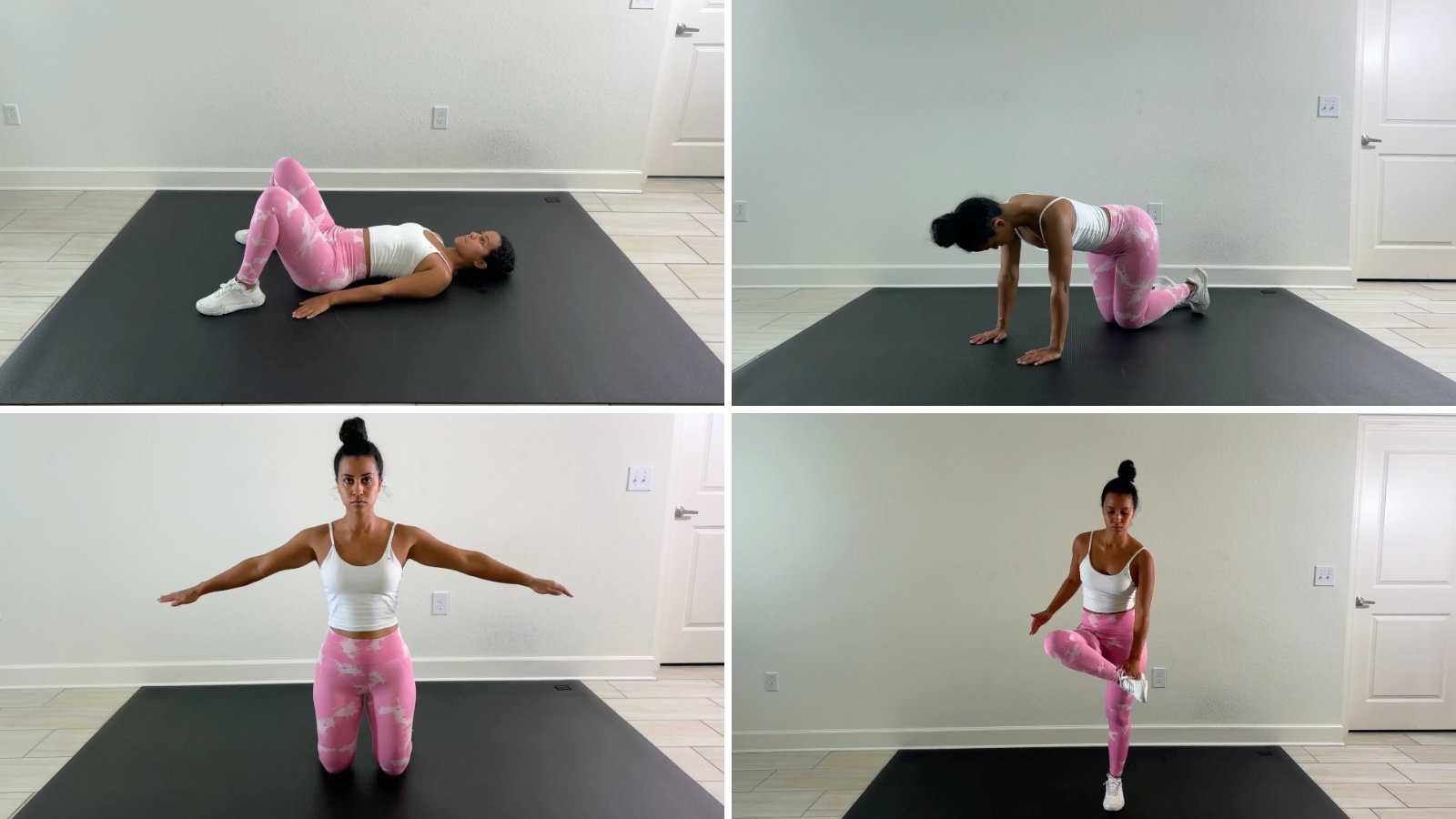
Yes, Pilates can help you lose weight, but it works best as part of a plan. It is light-to-moderate exercise that burns roughly 90–115 calories in 30 minutes, so pair it with brisk walking or other cardio and a modest calorie deficit. Pilates builds strength and is gentle enough to do often.
Below: what the studies found, whether Pilates reduces belly fat, how often to do it, a 20-minute Pilates workout with a short video demo for every move, and a sample week that adds cardio.
In this guide
- How many calories does Pilates burn?
- What studies say about Pilates and weight loss
- Can Pilates reduce belly fat?
- How to use Pilates for weight loss (and how often)
- A 20-minute Pilates workout for weight loss (with video demos)
- A sample week
- Mat, reformer or wall Pilates for weight loss?
- Frequently asked questions
How many calories does Pilates burn?
Pilates is generally light-to-moderate exercise. A 2026 systematic review estimated that a typical session works at about 3 METs (about three times your resting energy use) and burns about 3 calories a minute in the most reliable studies, with estimates of up to about 3.8 calories a minute across all the studies.
That works out to roughly 90–115 calories in a 30-minute session. Your own number depends on your body weight, the type of Pilates and how much you rest. For comparison, brisk walking is also moderate intensity, while HIIT is vigorous.
One useful finding: sessions with short rests (60 seconds or less) were linked to higher intensity. Moving steadily from one exercise to the next makes Pilates more demanding.
Is Pilates cardio or strength training? It is mainly muscular endurance and control work done at a light-to-moderate intensity. That makes it a good partner for cardio, not a replacement for it, when your goal is to burn more calories.
What studies say about Pilates and weight loss
The research is mixed. A 2021 meta-analysis of 11 randomized trials with 393 adults with overweight or obesity found that Pilates reduced body weight, BMI and body fat percentage, but not waist size or lean mass. The effect on weight was clearer in longer programs, and the authors called for larger, better-designed trials.
A 2020 meta-analysis of 10 studies was more cautious. It found that mat Pilates was no more effective than other types of exercise, or than control groups, at changing BMI, lean mass, body fat percentage or waist size, including in people with overweight or obesity.
Two small trials show what a program can look like. Sedentary women with overweight or obesity who did 90-minute Pilates sessions three times a week for 8 weeks lost weight, body fat and waist size, while a group that didn’t exercise did not. In a 2024 preliminary study, women with obesity who all followed a Mediterranean diet and also did 12 weeks of online mat Pilates at home, three times a week (180 minutes a week in total), lowered their body fat percentage and gained muscle compared with women who followed the diet alone.
Put together: Pilates can help, especially over a few months and alongside healthy eating, but the trials are small and there is little evidence that it works better than other exercise. It is not a shortcut. Here is what Pilates does well:
- Builds strength and endurance. Twelve weeks of twice-weekly mat Pilates improved abdominal endurance, hamstring flexibility and upper-body endurance in a randomized trial.
- Is low impact. It is gentle on your joints, so you can do it often, including between harder workouts.
- May ease back pain. A Cochrane review found low- to moderate-quality evidence that Pilates reduces pain and disability compared with minimal treatment, although not more than other exercise.
- Is easy to stick with. Many people enjoy Pilates, and the workout you enjoy is the one you keep doing.
Can Pilates reduce belly fat?
No exercise can burn fat in one spot. In a study where people did ab exercises five days a week for six weeks, their abs got stronger but their belly fat didn’t change. Pilates strengthens your core, while overall fat loss from diet and total activity reduces belly fat over time. For core moves, see our Pilates ab workout.
How to use Pilates for weight loss (and how often)
- Do Pilates 3–4 times a week. The two trials above used three sessions a week, but those sessions added up to 3 to 4.5 hours a week, far more than doing the 20-minute workout below three times. So pair shorter sessions with walking or other cardio. Take a rest day or a lighter day when you are sore.
- Keep rests short. Move through your routine with 60 seconds of rest or less, like the workout below.
- Add cardio. Walk briskly most days, for example with a 30-minute indoor walking workout or other steady-state cardio, or add two cardio sessions a week. The WHO recommends 150–300 minutes of moderate activity a week, and more than 250 minutes a week is linked to clinically meaningful weight loss.
- Eat in a modest calorie deficit. Exercise works best alongside a moderate cut in calories, with plenty of protein, vegetables and fiber.
- Track more than the scale. Measure your waist, notice how your clothes fit and track your strength.
A 20-minute Pilates workout for weight loss (with video demos)
This Pilates-inspired circuit mixes standing moves with mat and plank work. Rests are only 20 seconds; the 2026 review above linked short rests to higher intensity. It is low impact, with no jumping. Do it on its own or before a walk, as in the sample week below. For classic mat moves such as the hundred and the roll-up, see our beginner Pilates routine.
| Part | What to do | Time |
|---|---|---|
| Warm-up | March in place (1 minute), then cat-cow (1 minute) | 2 min |
| Round 1 | Moves 1–8 below: 40 seconds of work, then 20 seconds of rest | 8 min |
| Round 2 | Repeat moves 1–8 | 8 min |
| Cool-down | Child’s pose with slow breathing | 2 min |
Ready for more? Add a third round, or shorten the rests to 15 seconds. Stop any move that causes pain.
Warm-up (2 minutes)
March in place
Lift one knee at a time at an easy pace, arms relaxed by your sides, for 1 minute.
Cat-cow
On hands and knees, let your belly drop and lift your chest as you inhale, then round your back as you exhale. Continue for 1 minute.
The circuit: do moves 1–8 for 40 seconds each with 20 seconds of rest in between, then repeat the whole circuit once.
1. Squat side kick
Why it helps: Works your thighs and glutes and challenges your balance.
- Stand with your feet hip-width apart and your hands together in front of your chest.
- Sit back into a squat, keeping your chest up and your knees in line with your toes.
- As you stand, shift onto one leg and lift the other leg out to the side. Lower it, squat again and kick with the other leg.
Easier: Make the squat shallower and tap your foot out to the side instead of lifting it. Harder: Lift the leg a little higher and pause at the top.
Form tips, common mistakes and muscles worked: squat side kick exercise guide
2. Curtsy squat
Why it helps: Targets your glutes, including the sides of your hips, and your thighs.
- Stand tall with your hands together in front of your chest.
- Step one foot back and across behind the other, as if you were curtsying, and bend both knees.
- Push through your front foot to return to standing, then switch sides.
Easier: Take a smaller step and hold the back of a chair for balance. Harder: Lower more slowly and sink a little deeper.
3. Plié squat with arm circles
Why it helps: Works your inner thighs, glutes and shoulders at the same time, so more of your body is moving.
- Stand with your feet wide and your toes turned out, arms reaching overhead.
- Bend your knees into a wide squat as you circle your arms out and down toward the floor.
- Press up to standing as you circle your arms back up overhead.
Easier: Squat only partway down and keep your arm circles smaller. Harder: Pause for a breath at the bottom of each squat.
Form tips, common mistakes and muscles worked: plié squat arm circles exercise guide
4. Plank walk-out
Why it helps: A full-body move that works your shoulders, arms and core and stretches the backs of your legs.
- Start bent forward with your hands on the floor and your hips high, like an upside-down V.
- Walk your hands forward until you are in a high plank, with your body in a straight line.
- Pause, then walk your hands back to the start.
Easier: Bend your knees as much as you need and walk only partway out. Harder: Hold the plank for a few breaths before you walk back.
Form tips, common mistakes and muscles worked: plank walk-out exercise guide
5. Bear plank shoulder taps
Why it helps: Builds core control, because your abs work to keep your hips still each time a hand lifts.
- Start on your hands and knees with your hands under your shoulders and your knees under your hips.
- Tuck your toes and lift your knees an inch or two off the floor.
- Keeping your hips steady, tap one hand to the opposite shoulder, put it back down and switch.
Easier: Keep your knees on the floor while you tap. Harder: Tap more slowly and hold each tap for a second.
Form tips, common mistakes and muscles worked: bear plank shoulder taps exercise guide
6. Mountain climber walk
Why it helps: A slow, no-jump take on mountain climbers that keeps your core working and your legs moving.
- Start in a high plank with your hands under your shoulders.
- Step one foot forward toward your hands, then the other, so your knees bend under your hips.
- Step back to the plank one foot at a time and repeat.
Easier: Step just one foot in and back at a time, alternating legs. Harder: Move a little faster while keeping every step controlled.
7. Glute bridge
Why it helps: Strengthens your glutes and the backs of your thighs. It is a close cousin of the Pilates pelvic curl.
- Lie on your back with your knees bent, feet flat and hip-width apart, and arms by your sides.
- Press through your heels to lift your hips until your body makes a line from your shoulders to your knees.
- Lower with control and repeat.
Easier: Lift your hips only partway. Harder: Pause and squeeze your glutes for two seconds at the top.
Form tips, common mistakes and muscles worked: glute bridge exercise guide
8. Side-lying leg circles
Why it helps: Works your outer hips and glutes while your core keeps your body steady.
- Lie on your side propped on your forearm, with your legs straight and stacked and your top hand on the mat in front of you.
- Lift your top leg and draw large, slow circles with it, keeping your hips stacked.
- Reverse the direction halfway through. Work one leg in round 1 and the other leg in round 2.
Easier: Rest your head on your lower arm, bend your bottom knee and make the circles smaller. Harder: Keep the leg lifted the whole time without touching it down.
Cool-down (2 minutes)
Child's pose
Sit your hips back toward your heels, reach your arms forward and breathe slowly.
A sample week
| Day | Workout |
|---|---|
| Monday | The 20-minute Pilates workout above + 30-minute walk |
| Tuesday | Brisk walk or low impact cardio (30–45 min) |
| Wednesday | Wall Pilates (20–30 min) + 15-minute walk |
| Thursday | Brisk walk (45 min) |
| Friday | Beginner Pilates routine (20–30 min) + 15-minute walk |
| Saturday | Longer walk, bike ride or another activity you enjoy (60 min) |
| Sunday | Rest or gentle stretching |
That adds up to roughly 255–290 minutes of activity a week, enough to support weight loss alongside healthy eating. Want a harder session on a cardio day? Try our no-equipment home workout for weight loss.
Mat, reformer or wall Pilates for weight loss?
Reformer Pilates uses a machine with springs for resistance, so it can feel more like strength training. Mat Pilates uses your body weight and can be done anywhere. Wall Pilates uses the same kind of bodyweight moves, with a wall for support. All three are mostly light-to-moderate in intensity, so the same rule applies: combine any of them with cardio and healthy eating, and choose the one you will do consistently. To try wall Pilates, see our wall Pilates routine for beginners.
Make Pilates a habit. Pilates Workout at Home has beginner-friendly mat and wall Pilates sessions with video, timers and spoken cues, plus a 56-day plan at Beginner, Intermediate or Advanced level.
Frequently asked questions
Can you lose weight doing only Pilates?
Yes, it is possible, especially if you also eat in a modest calorie deficit. In small trials, adults with overweight or obesity lost some weight and body fat with Pilates compared with no exercise, and a 12-week home Pilates program plus diet lowered body fat percentage more than diet alone. Because Pilates is light-to-moderate exercise, adding walking or other cardio burns more calories and usually brings faster progress.
How long does it take to lose weight with Pilates?
Give it at least two to three months. Two small trials that found changes in weight or body fat ran for 8 and 12 weeks, with three Pilates sessions a week totaling 3 to 4.5 hours, and a 2021 review found the effect on weight was clearer in longer programs. How much you lose depends mostly on your overall activity and diet, so track your waist, strength and how your clothes fit as well as the scale.
Is 30 minutes of Pilates a day enough to lose weight?
It can help, especially alongside a modest calorie deficit. A 30-minute session burns roughly 90–115 calories, so adding brisk walking or other cardio raises your weekly total. The WHO recommends 150–300 minutes of moderate activity a week. If you do Pilates every day, vary the moves and take a lighter day or a rest day when you are sore.
How many times a week should I do Pilates to lose weight?
Aim for three to four sessions a week. Two small trials that found changes in weight or body fat used three Pilates sessions a week, totaling 3 to 4.5 hours. If your sessions are shorter, add brisk walking or other cardio on most days, and keep one day a week for rest or gentle stretching.
Is Pilates or yoga better for weight loss?
Neither is a high-calorie workout, and both can support weight loss as part of an active routine with healthy eating. Pick the one you enjoy and will do regularly, and add cardio such as brisk walking. For a full comparison, see Pilates vs yoga.
Is Pilates better than walking for weight loss?
They do different jobs. Walking is easy to do for longer, so it adds more minutes of activity; Pilates builds strength and core control. Doing both works well: try Pilates three or four times a week and an indoor walking workout or an outdoor walk on most days.
Start with a guided session. Download Pilates Workout at Home and follow a plan made for your level.
References
- Vitor GBB, et al. Metabolic intensity and energy cost of Pilates exercises: an exploratory systematic review and meta-analysis. Syst Rev. 2026. PubMed
- Wang Y, et al. Pilates for Overweight or Obesity: A Meta-Analysis. Front Physiol. 2021. PubMed
- Cavina APS, et al. Effects of the Mat Pilates Method on Body Composition: Systematic Review With Meta-Analysis. J Phys Act Health. 2020. PubMed
- Şavkin R, Aslan UB. The effect of Pilates exercise on body composition in sedentary overweight and obese women. J Sports Med Phys Fitness. 2017. PubMed
- Greco F, et al. The Effects of Online Home-Based Pilates Combined with Diet on Body Composition in Women Affected by Obesity: A Preliminary Study. Nutrients. 2024. PubMed
- Kloubec JA. Pilates for improvement of muscle endurance, flexibility, balance, and posture. J Strength Cond Res. 2010. PubMed
- Yamato TP, et al. Pilates for low back pain. Cochrane Database Syst Rev. 2015. PubMed
- Vispute SS, et al. The effect of abdominal exercise on abdominal fat. J Strength Cond Res. 2011. PubMed
- Bull FC, et al. World Health Organization 2020 guidelines on physical activity and sedentary behaviour. Br J Sports Med. 2020. PubMed
- Donnelly JE, et al. ACSM Position Stand: Appropriate physical activity intervention strategies for weight loss and prevention of weight regain for adults. Med Sci Sports Exerc. 2009. PubMed
This article is general information, not medical advice. Check with your doctor before starting a new exercise program, especially if you are pregnant, recently gave birth, or have a health condition, injury or joint pain.
Try LifeBuddy's free workout apps
- Dumbbell Home Workout: build muscle at home with dumbbells
- Weight Loss Workout At Home: no-equipment workouts to lose weight
- Pilates Workout at Home: beginner-friendly mat and Wall Pilates