

Pilates for Beginners at Home (12 MAT EXERCISES WITH VIDEOS, A 20-MINUTE ROUTINE AND A 4-WEEK PLAN)
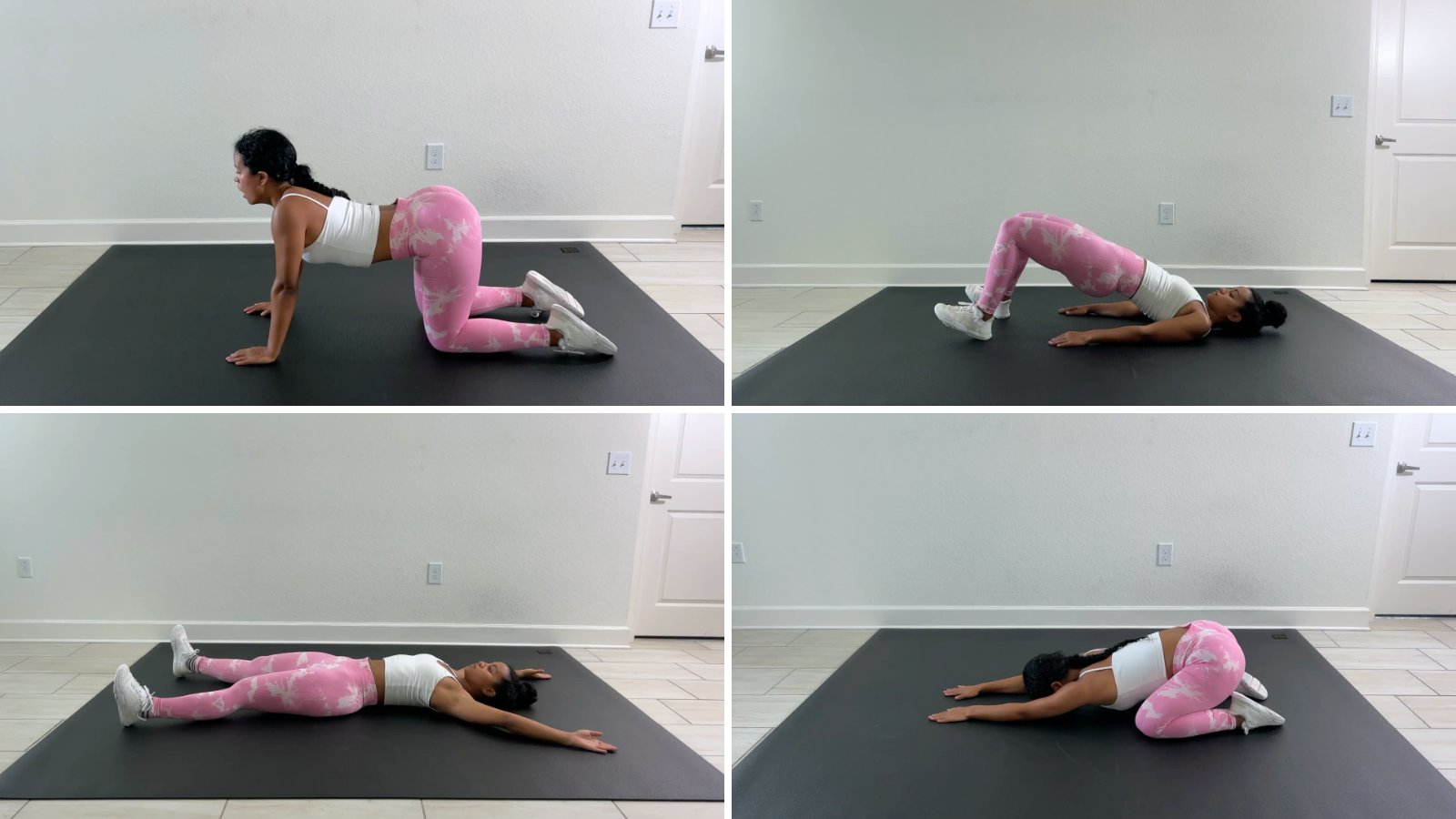
To start Pilates at home as a beginner, you need a mat, a little floor space and about 20 minutes two or three times a week. Learn to breathe steadily and engage your core, then work through the 12 moves below slowly, using the easier versions until your form feels steady.
Pilates is a low-impact way to build core strength, flexibility and control, and you don’t need a studio or a reformer machine. In this guide to Pilates for beginners at home, every exercise has a short video demo and step-by-step cues, and most include an easier or harder option. You’ll also find a 20-minute routine, a 4-week plan and the basics of Pilates breathing and form.
In this guide
What you need to start Pilates at home
- A mat. A cushioned exercise mat is the most comfortable. On a hard floor without one, fold a blanket under your spine and knees.
- Floor space to lie down with your arms overhead and your legs long. A clear patch of wall to lean against helps for spine stretch forward.
- Comfortable clothes you can move in. Bare feet, grip socks or light sneakers all work.
- A small towel or pillow to rest your head on if your neck tires, or to sit on if your hamstrings feel tight.
That’s it. You don’t need a reformer, ring, ball or resistance bands to start, because mat Pilates uses your body weight.
Pilates basics for beginners
- Breathe. Inhale through your nose to prepare and exhale through your mouth as you move. Let each breath widen the sides and back of your ribs, and don’t hold your breath.
- Engage your core. Gently draw your belly button toward your spine, as if zipping up tight jeans, and keep breathing.
- Find a neutral spine. Lying on your back, keep a small natural curve under your lower back. Some moves ask you to press your lower back toward the mat for extra support.
- Choose control over speed. Slow, precise movements work your muscles harder than fast, sloppy ones. Move smoothly from one exercise to the next.
- Quality over quantity. Most Pilates exercises use 5–10 careful repetitions.
Pilates teachers often sum these ideas up as six principles: breath, concentration, centering, control, precision and flow. Not sure whether Pilates or yoga suits you better? See Pilates vs yoga.
12 beginner Pilates exercises
The list mixes classic Pilates mat moves with a few simple strength and stretching moves that prepare you for them. Each one has a short video demo, and they appear in the same order as the 20-minute routine below. Start with the easier version whenever a move feels like a strain.
1. Cat-cow
Why it helps: Gently mobilizes your spine and makes an easy warm-up.
- Start on your hands and knees, with wrists under shoulders and knees under hips.
- Inhale as you drop your belly and lift your chest (cow).
- Exhale as you round your back and tuck your chin (cat).
- Move slowly for 6–8 breaths.
Form tips, common mistakes and muscles worked: cat and cow sequence exercise guide
2. Glute bridge
Why it helps: Strengthens your glutes and hamstrings and teaches you to lift your hips with control.
- Lie on your back with your knees bent, feet flat on the mat about hip-width apart and arms by your sides.
- Exhale and press through your heels to lift your hips until your shoulders, hips and knees form a straight line.
- Hold for a few seconds while breathing steadily.
- Lower your hips slowly to the mat. Do 8 reps.
Easier: Lift your hips only partway and lower right away. Harder: Try the Pilates pelvic curl: tilt your pelvis first, then peel your spine up and back down one vertebra at a time.
Form tips, common mistakes and muscles worked: glute bridge exercise guide
3. Knee folds
Why it helps: Teaches your deep abs to keep your pelvis still while your legs move, the skill behind the hundred and single-leg stretch.
- Lie on your back with your knees bent, feet flat and arms by your sides, palms down.
- Exhale and lift one foot off the mat, drawing that bent knee up over your hip and in toward your chest.
- Inhale and lower the foot slowly back to the mat without letting your hips rock.
- Switch legs each time. Do 8 per side.
Easier: Lift your foot only a few inches off the mat. Harder: Lift both knees to tabletop, then lower one foot at a time to tap the mat.
4. The hundred
Why it helps: A classic Pilates warm-up that builds core endurance and breath control.
- Lie on your back and lift both legs straight toward the ceiling, then lower them slightly so they angle away from you.
- Lift your head and shoulders and reach your arms long by your sides, just above the mat.
- Pump your arms up and down in small, quick movements.
- Inhale for 5 pumps and exhale for 5 pumps. Work up to 10 breaths (100 pumps).
Easier: Bend your knees into tabletop (knees over hips, shins parallel to the floor), or keep your feet on the floor. Rest your head on the mat if your neck tires.
Form tips, common mistakes and muscles worked: hundred exercise guide
5. Roll-up
Why it helps: Strengthens your abs while stretching your spine and hamstrings.
- Lie on your back with your legs straight and arms reaching overhead.
- Inhale as you lift your arms toward the ceiling, then exhale as you curl your head, shoulders and spine off the mat.
- Reach toward your toes with a rounded back.
- Inhale, then exhale to roll back down one vertebra at a time.
Easier: Bend your knees, or do a half roll-back: sit tall, roll halfway back and return. Harder: Move slowly, with no momentum at all.
Form tips, common mistakes and muscles worked: roll-up exercise guide
6. Single-leg stretch
Why it helps: Trains your abs to keep your upper body still while your legs switch. In this version, your arms reach long by your sides.
- Lie on your back, lift your head and shoulders, and reach your arms long beside your hips.
- Lift both legs: draw your right knee toward your chest and extend your left leg out at an angle.
- Switch legs in a steady rhythm, keeping your head, shoulders and feet off the mat.
- Exhale on one switch and inhale on the next. Do 8–10 per side.
Easier: Keep your head down and extend your legs higher toward the ceiling.
Form tips, common mistakes and muscles worked: hollow body alternating knee raise exercise guide
7. Spine stretch forward
Why it helps: Stretches your back and hamstrings and teaches you to sit tall. Leaning against a wall helps you feel your spine round forward and stack back up.
- Sit tall with your back against a wall, legs straight and about hip-width apart, toes pointing up.
- Reach your arms forward at shoulder height.
- Exhale as you round forward, dropping your head and reaching toward your toes.
- Inhale to roll back up until your back rests against the wall. Do 5 reps.
Easier: If you have tight hamstrings, bend your knees slightly or sit on a folded towel. Harder: Sit away from the wall and keep your back tall on your own.
8. Prone X
Why it helps: Strengthens your back, glutes and shoulders to balance all the ab work.
- Lie on your stomach with your arms reaching forward past your head and your legs long.
- Lift your chest, arms and legs a little off the mat, keeping your legs straight, your neck long and your eyes on the floor.
- Sweep your arms out to the sides and back toward your hips as you open your legs wide, then sweep your arms forward again as you bring your legs back together.
- Do 5 slow sweeps, then lower and rest. Repeat once.
Easier: Keep your legs on the mat and lift only your chest and arms.
Form tips, common mistakes and muscles worked: prone X exercise guide
9. Side-lying leg lifts
Why it helps: Works the muscles on the outside of your hips and glutes.
- Lie on your side propped on your forearm, with your top hand on the mat in front of you.
- Keep both legs straight and stacked in line with your body.
- Lift your top leg as high as you can without rolling your hips back, then lower it slowly with control.
- Do 10–15 reps, then switch sides.
Easier: Rest your head on your lower arm instead of propping yourself up, and make the lift smaller.
10. Clamshell
Why it helps: Targets the glute muscles on the side of your hip.
- Lie on your side with your head resting on your lower arm, knees bent and feet in line with your hips.
- Keep your feet together and lift your top knee.
- Lower slowly without rolling your hips back.
- Do 12–15 reps, then switch sides.
Easier: Lift your knee only a little way, keeping your hips still.
11. Kneeling plank
Why it helps: Builds the core strength you need for harder Pilates moves.
- Start on your forearms and knees with your elbows under your shoulders.
- Walk your knees back until your body is straight from head to knees.
- Draw your belly in and keep your hips level.
- Hold for 20–30 seconds while breathing steadily.
Easier: Hold for 10–15 seconds and build up over a few sessions. Harder: Lift your knees so only your forearms and toes touch the mat (a full forearm plank), or try a high plank on your hands. See planks for beginners for more.
Form tips, common mistakes and muscles worked: kneeling plank exercise guide
12. Child's pose
Why it helps: A relaxing stretch for your back and hips to finish.
- Kneel and sit back toward your heels.
- Fold forward and rest your arms on the mat in front of you.
- Breathe deeply into your back for 30–60 seconds.
Form tips, common mistakes and muscles worked: child's pose exercise guide
20-minute beginner Pilates routine
Do the moves in this order for a complete beginner Pilates workout at home. Times are approximate and include switching sides.
| Exercise | Reps or time | Approx. time |
|---|---|---|
| Cat-cow | 6–8 breaths | 1 min |
| Glute bridge | 8 reps | 1½ min |
| Knee folds | 8 per side | 1½ min |
| The hundred | 50–100 pumps | 2 min |
| Roll-up or half roll-back | 6 reps | 1½ min |
| Single-leg stretch | 8 per side | 1 min |
| Spine stretch forward | 5 reps | 1 min |
| Prone X | 2 × 5 sweeps | 1½ min |
| Side-lying leg lifts | 12 per side | 2½ min |
| Clamshell | 12 per side | 2 min |
| Kneeling plank | 2 × 20–30 seconds | 1½ min |
| Child’s pose | 60 seconds | 1 min |
The moves take about 18 minutes, and short pauses between them bring the session to about 20. As you get stronger, repeat the middle section or try the harder versions.
Short on time? For a 10-minute version, do cat-cow, glute bridge, knee folds, the hundred, clamshell, kneeling plank and child’s pose.
4-week beginner Pilates plan
This suggested plan eases you in gradually. It’s a simple progression, not a tested program, so adjust it to how you feel.
| Week | Sessions | What to do |
|---|---|---|
| Week 1 | 2 × 10–15 min | Cat-cow, glute bridge, knee folds, side-lying leg lifts, clamshell, kneeling plank and child’s pose. Focus on breathing and engaging your core. |
| Week 2 | 2 × 15 min | Add the hundred with your knees in tabletop, single-leg stretch with your head down, spine stretch forward and prone X with your legs on the mat. |
| Week 3 | 2–3 × 20 min | The full 20-minute routine, using the easier versions where you need them. Start with the half roll-back. |
| Week 4 | 3 × 20–30 min | The full routine. Try one harder version, or repeat the middle section (the hundred through prone X). |
Move on to the next week only when every move feels controlled and you can breathe normally through it. Repeating a week is fine. On other days, rest, go for a walk or do a gentle full body stretch.
How often should beginners do Pilates?
Start with 2–3 sessions a week, with a rest day or other activity in between. In a 12-week study of active middle-aged adults, two 60-minute mat Pilates classes a week improved abdominal endurance, hamstring flexibility and upper-body endurance. Pilates is light-to-moderate exercise, so also add regular walking or other cardio to cover the rest of your weekly activity: try this indoor walking workout or some low-impact cardio. When the basics feel easy, try wall Pilates or our Pilates ab workout.
Pilates may also help with non-specific low back pain: a Cochrane review found low- to moderate-quality evidence that it reduces pain and disability more than minimal treatment, but it hasn’t been shown to work better than other types of exercise.
Common beginner mistakes
- Holding your breath. Keep breathing throughout every move.
- Straining your neck. Look toward your knees, and rest your head if your neck gets tired.
- Arching your lower back during leg moves. Bend your knees or lift your legs higher to make it easier.
- Rushing. Slow down; control is the point.
- Doing too much at once. A short routine done regularly beats an occasional long one.
Stay safe. If you are pregnant or recently gave birth, or have osteoporosis, a back, neck or joint condition, or recent surgery, ask your doctor or physical therapist which moves suit you. Stop any exercise that causes sharp pain, dizziness or numbness.
Follow along with video. Pilates Workout at Home starts at a Beginner level with short guided sessions, video demonstrations, timers and spoken cues, and builds into a 56-day plan.
Frequently asked questions
Can I teach myself Pilates at home?
Yes, you can learn the basics at home. Start with simple mat moves like the ones above, go slowly and use the easier versions until your form feels steady. Watch each video demo and compare it with how you move, or film yourself. If you have an injury or health condition, or a move hurts, ask a qualified instructor or physical therapist to check your form.
What equipment do I need for Pilates at home?
Just a mat, or a folded blanket on carpet, and enough space to lie down with your arms and legs stretched out. Mat Pilates uses your body weight. A reformer, which adds spring resistance, and props such as a ring, ball or bands are optional extras, not requirements. A small towel or pillow can support your head or raise your hips when you sit.
Is Pilates hard for beginners?
Research, though limited, suggests Pilates is light-to-moderate exercise. It can still feel challenging at first because every move asks for slow control and steady breathing. Most exercises in this guide have an easier version, so start there and progress only when your form stays steady. If a move strains your neck or lower back, switch to the easier version or rest.
Is 20 minutes of Pilates a day enough?
Yes, 20 minutes is enough for a beginner session, and you don’t need to do it every day: two or three sessions a week is a realistic start. For overall health, U.S. guidelines advise adults to get at least 150 minutes of moderate aerobic activity a week plus muscle-strengthening activity on at least 2 days, so pair Pilates with walking or other low-impact cardio.
How long until I see results from Pilates?
It depends on where you start and how often you practice. In one study of active middle-aged adults, two 1-hour mat Pilates classes a week for 12 weeks improved abdominal endurance, hamstring flexibility and upper-body endurance, though not posture or balance. Track your progress by how many controlled reps you can do and when the harder versions start to feel manageable.
Can I do Pilates every day?
Gentle Pilates can be done on most days because it is low-impact. Still, 2–3 sessions a week is a good start for beginners, with walking or other activity on the remaining days. If your muscles are still sore or a move starts to hurt, take a rest day or do only the gentle stretches, such as cat-cow and child’s pose.
Can Pilates help me lose weight?
Pilates is light-to-moderate exercise, so on its own it isn’t a fast way to burn calories, and no exercise burns fat from one chosen spot. In one study, six weeks of ab exercises alone didn’t reduce belly fat. Weight loss depends on your overall activity and eating habits, so pair Pilates with cardio. Read more on whether Pilates helps with weight loss.
Is Pilates good for back pain?
It may help. A Cochrane review found low- to moderate-quality evidence that Pilates reduces pain and disability from non-specific low back pain more than minimal treatment, but it hasn’t been shown to work better than other types of exercise. If you have a back condition, ask your doctor or physical therapist which moves suit you, and stop any move that causes pain.
Start your first session. Download Pilates Workout at Home and begin at the Beginner level.
References
- Kloubec JA. Pilates for improvement of muscle endurance, flexibility, balance, and posture. J Strength Cond Res. 2010. PubMed
- Vitor GBB, et al. Metabolic intensity and energy cost of Pilates exercises: an exploratory systematic review and meta-analysis. Syst Rev. 2026. PubMed
- Yamato TP, et al. Pilates for low back pain. Cochrane Database Syst Rev. 2015. PubMed
- U.S. Department of Health and Human Services, Office of Disease Prevention and Health Promotion. Top 10 Things to Know About the Second Edition of the Physical Activity Guidelines for Americans. Source
- Vispute SS, et al. The effect of abdominal exercise on abdominal fat. J Strength Cond Res. 2011. PubMed
This article is general information, not medical advice. Check with your doctor before starting a new exercise program, especially if you are pregnant, recently gave birth, or have a health condition, injury or joint pain.
Try LifeBuddy's free workout apps
- Dumbbell Home Workout: build muscle at home with dumbbells
- Weight Loss Workout At Home: no-equipment workouts to lose weight
- Pilates Workout at Home: beginner-friendly mat and Wall Pilates