

Wall Pilates for Beginners (8 EXERCISES WITH VIDEO DEMOS, A 20-MINUTE ROUTINE AND A 4-WEEK PLAN)
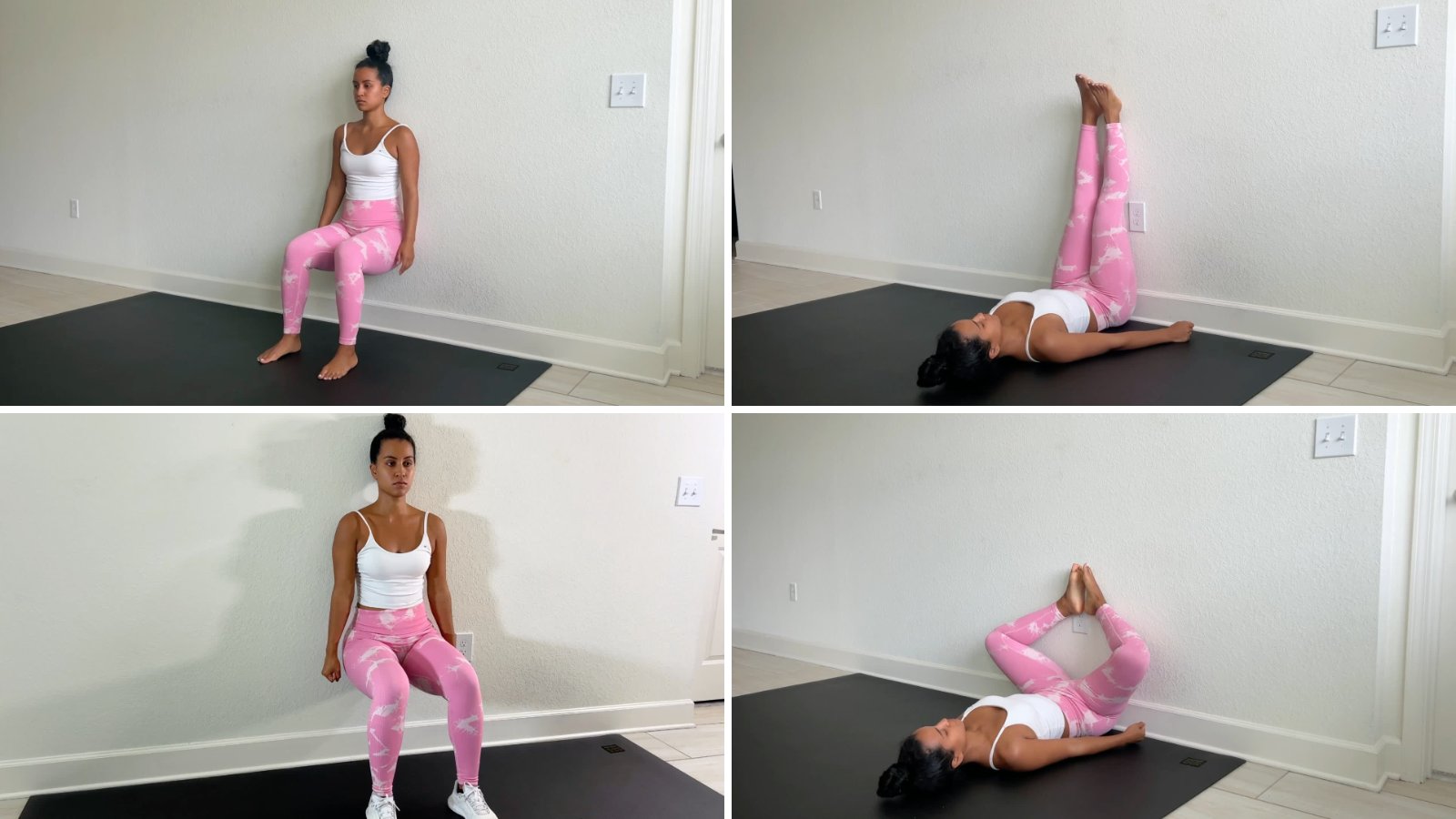
Wall Pilates for beginners is mat Pilates with a wall for support. You press your feet, back or hands into the wall to steady yourself, which makes the moves easier to learn. Start with the 8 moves below, each with a short video demo, then follow the 4-week plan: one round of the circuit 3 times a week at first, building up to the full 20-minute routine. All you need is a clear wall and a mat.
In this guide
What is wall Pilates?
Wall Pilates is mat Pilates with a wall as your prop. You lie with your feet on the wall for bridges and core work, lean against it for wall sits, and hold on to it for standing moves such as lunges. It is low impact, quiet and suitable for most fitness levels.
Is wall Pilates good for beginners? Yes. The wall steadies you and gives you feedback on your position, which makes moves like bridges and wall sits easier to learn, and every move can be made smaller or bigger to suit your level. There is little research on wall Pilates itself, but in a randomized trial of active middle-aged adults, two 60-minute mat Pilates classes a week for 12 weeks improved abdominal endurance, hamstring flexibility and upper-body muscular endurance.
What you need and how to set up
All you need is a sturdy, clear wall, a mat or other soft surface, and bare feet or grippy socks. Small balls and bands are optional extras, not requirements.
- Place your mat with its short end against a clear wall.
- Work barefoot or in grippy socks so your feet don’t slip.
- Move slowly and breathe steadily, exhaling on the effort.
- Keep your lower back comfortable. If it arches or aches, make the movement smaller.
8 wall Pilates exercises for beginners
Every move below uses the wall and has a short video demo. Watch the demo, then follow the steps. Start with the easier option if a move feels hard, and switch sides where the steps say so.
1. Wall bridge
Why it helps: Strengthens your glutes and hamstrings, and the wall helps you find the right foot position.
- Lie on your back with your arms by your sides and your hips about 30–60 cm (1–2 ft) from the wall.
- Place your feet flat on the wall with your knees bent about 90 degrees.
- Press your feet into the wall and peel your hips up one vertebra at a time.
- Pause at the top, then roll down slowly.
Easier: Lift your hips only halfway. Harder: Hold at the top and pulse up 10 times, or try a single-leg wall bridge: straighten one leg toward the ceiling and lift and lower your hips with the other foot on the wall.
2. Wall sit
Why it helps: Builds strength in your thighs and glutes with no impact.
- Stand with your back against the wall and walk your feet forward.
- Slide down until your knees are bent, ideally close to 90 degrees.
- Keep your knees over your ankles and your back flat against the wall.
- Hold for 20–45 seconds and keep breathing.
Easier: Slide only partway down. Harder: Lift your heels, or hold for longer.
3. Wall-supported lunge
Why it helps: Works your thighs and glutes one leg at a time, while the wall helps you balance.
- Stand facing the wall with your hands flat on it at about shoulder height.
- Step one foot back into a split stance, with your back heel lifted.
- Bend both knees to lower your back knee toward the floor, keeping your hands on the wall for balance.
- Press through your front foot to rise. Do 8–10 reps, then switch legs.
Easier: Lower only partway. Harder: Pause for 2 seconds at the bottom of each rep.
4. Wall push-up
Why it helps: Strengthens your chest, shoulders and arms.
- Stand slightly more than arm’s length from the wall with your hands on it, a little wider than your shoulders.
- Keep your body straight from head to heels.
- Bend your elbows to bring your chest toward the wall, then push back.
Easier: Stand closer to the wall. Harder: Lower slowly over 3 seconds.
Form tips, common mistakes and muscles worked: wall push-up exercise guide
5. Wall single-leg opener
Why it helps: Trains your deep core to keep your pelvis steady while one leg opens, and works your inner thighs.
- Lie on your back with your hips a short distance from the wall and your arms stretched out to the sides.
- Place one foot flat on the wall with that knee bent, and straighten the other leg up toward the ceiling.
- Gently draw your belly in. Keeping both hips level on the mat, slowly lower the straight leg out to the side toward the floor, only as far as your pelvis stays still.
- Lift it back to center. Do 8–10 reps, then switch legs.
Easier: Open the leg only a short way, or keep a slight bend in the moving knee. Harder: Take 3–4 seconds to lower the leg out to the side.
6. Wall Russian twist
Why it helps: Works the muscles along the sides of your waist (your obliques) and your deep core, with the wall supporting your feet.
- Sit on your mat facing the wall with your knees bent and the soles of your feet flat on the wall.
- Lean back a little, keeping your back long.
- Turn your upper body to one side and reach both hands toward the floor beside your hip.
- Come back through the middle and twist to the other side. Do 8–10 twists per side.
Easier: Sit taller and make the twist smaller. Harder: Lean back a little farther and twist more slowly.
7. Wall butterfly stretch
Why it helps: Gently stretches your inner thighs and hips.
- Lie on your back with your hips close to the wall and your arms by your sides.
- Bend your knees, press the soles of your feet together against the wall, and let your knees fall open to the sides.
- Hold, or let your knees gently open and close a little, for 30–60 seconds while you breathe slowly.
Easier: Move your hips farther from the wall to ease the stretch.
8. Legs-up-the-wall straddle stretch
Why it helps: A relaxing stretch for your inner thighs and the backs of your legs to finish your session.
- Sit sideways next to the wall, then lie back and swing your legs up it, with your hips close to the wall and your arms by your sides.
- Breathe slowly for a few breaths with your legs together.
- Let your legs slide apart along the wall into a wide V, only as far as is comfortable, and hold for a few breaths.
- Bring your legs back together. Repeat slowly for 1–2 minutes.
Easier: Bend your knees slightly (useful if you have tight hamstrings), or skip the V and simply rest with your legs up the wall.
20-minute wall Pilates routine
| Exercise | Reps or time | Main muscles |
|---|---|---|
| Wall bridge | 12 reps | Glutes, hamstrings |
| Wall sit | 30 seconds | Thighs, glutes |
| Wall-supported lunge | 8 per side | Thighs, glutes |
| Wall push-ups | 10 reps | Chest, shoulders, arms |
| Wall single-leg opener | 8 per side | Deep core, inner thighs |
| Wall Russian twist | 8 per side | Obliques, deep core |
| Wall butterfly stretch (cool-down) | 30–60 seconds | Inner thighs, hips |
| Legs-up-the-wall straddle stretch (cool-down) | 1–2 minutes | Inner thighs, hamstrings |
Warm up with 2 minutes of marching in place and shoulder rolls. Then do the first 6 moves as a circuit twice, resting about 30 seconds between exercises and 1 minute between rounds. Finish with the 2 stretches once. Short rests keep the session more demanding: in a 2026 review of Pilates studies, rest periods of 60 seconds or less were linked to higher intensity.
4-week (28-day) wall Pilates plan for beginners
| Week | Sessions | Routine |
|---|---|---|
| 1 | 3 a week | 1 round of the circuit, focusing on form, then the stretches |
| 2 | 3 a week | 2 rounds |
| 3 | 4 a week | 2 rounds, using the harder versions of the wall bridge and wall sit |
| 4 | 4 a week | 2–3 rounds, adding holds and pulses |
Start with 3 sessions a week on non-consecutive days. On the other days, take a brisk walk (or try this indoor walking workout) or rest. The CDC advises adults to get at least 150 minutes of moderate activity, such as brisk walking, each week, plus muscle-strengthening activity on at least 2 days. In the 12-week trial above, two sessions a week were enough to improve muscular endurance and flexibility, so you don’t need to train every day to see gains. For more lower-body moves, see our glute exercises.
After 4 weeks: how to make it harder
- Slow down: take 3–4 seconds to lower in the bridges, lunges and leg openers.
- Add a 2–3 second hold at the top of each wall bridge or the bottom of each lunge.
- Switch to one-leg versions, such as the single-leg wall bridge.
- Hold the wall sit for longer, or do 3 rounds of the circuit. For extra core work, add our Pilates ab workout.
Wall Pilates vs mat Pilates vs reformer
| Wall Pilates | Mat Pilates | Reformer Pilates | |
|---|---|---|---|
| What you need | A clear wall and a mat | A mat | A reformer machine, usually at a studio |
| Support | The wall steadies you and gives you something to press against | No prop, so you rely on your own control | Springs and a sliding carriage add resistance or support |
| Variety | Fewer moves, focused on legs, glutes, core and stretching | A wide range of bodyweight moves | A wide range of moves, usually taught in a class |
| Good for | Learning form with support at home | Practicing anywhere, with no equipment | Spring resistance with a teacher’s guidance |
No study has compared wall and mat Pilates head to head, so neither is proven better. Many people use both: the wall for support while they learn, and the mat for more variety. For mat moves, see our guide to Pilates for beginners at home.
Is wall Pilates good for weight loss?
Wall Pilates builds muscular endurance and control, but it is not a big calorie burner on its own. A 2026 review estimated that a typical Pilates session is light-to-moderate in intensity, and a 2020 review found that mat Pilates did not change body composition more than other types of exercise. For weight loss, combine wall Pilates with walking or other low-impact cardio and healthy eating. See what research says about Pilates and weight loss.
Safety tips
- Stop any move that causes pain, especially in your neck, lower back or knees.
- If you are pregnant, recently gave birth, or have osteoporosis or a back condition, ask your doctor or a physical therapist which moves suit you.
- Keep your neck relaxed and don’t press your head into the floor.
- In the stretches, go only as far as feels comfortable: a gentle pull, never pain.
Follow a guided plan. Pilates Workout at Home includes Wall Pilates and mat Pilates sessions with video demonstrations and spoken cues, organized into a 56-day plan around your level and schedule.
Frequently asked questions
Is wall Pilates good for beginners?
Yes. The wall gives you support and feedback, which makes it easier to learn good form. The moves are low impact, you need only a wall and a mat, and each move has an easier option, so you can start at your own level.
How often should I do wall Pilates?
Three or four sessions a week is a good start: about 10–15 minutes at first, building up to 20 minutes or more, as in the 4-week plan in this guide. Wall Pilates is low impact, but you don’t need to do it every day. Walk or rest on the other days, and take a day off if your muscles are still sore.
Can wall Pilates help me lose weight?
It can be part of a weight-loss routine, but on its own it is light-to-moderate exercise, and a review found mat Pilates no better than other exercise for changing body composition. Combine wall Pilates with walking or other cardio and healthy eating.
Do I need any equipment for wall Pilates?
Just a clear, sturdy wall and a mat or soft surface. Bare feet or grippy socks stop your feet from slipping. Balls, bands and other props are optional.
Is a 28-day wall Pilates challenge worth it?
A 4-week plan is a good way to build the habit and learn the moves. Don’t expect big changes in 28 days: in a mat Pilates trial with two 60-minute classes a week, gains in endurance and flexibility were measured after 12 weeks. Changes in body shape also depend on your overall activity and diet, so keep going after the challenge.
Is wall Pilates better than mat Pilates?
Neither is better overall, and no study has compared them directly. The wall gives you support and feedback, which helps while you’re learning, while mat Pilates offers more variety. Many people do both. To add mat work, see our beginner mat Pilates guide.
How many calories does wall Pilates burn?
No study has measured wall Pilates on its own. For Pilates in general, a 2026 review’s most reliable estimate was about 3 calories a minute, based on limited, low-certainty evidence. Your number depends on your body size, the moves you choose and how much you rest. For more detail, see our guide to how many calories Pilates burns.
Can wall Pilates help you lose belly fat?
Not directly. You can’t burn fat from one spot by working the muscles there: in a study where people did ab exercises 5 days a week for 6 weeks, their ab endurance improved but their belly fat did not change. Wall Pilates works your core and legs, while losing belly fat depends on overall weight loss through activity and diet.
Ready to start? Download Pilates Workout at Home for guided Wall Pilates workouts at your level.
References
- Kloubec JA. Pilates for improvement of muscle endurance, flexibility, balance, and posture. J Strength Cond Res. 2010. PubMed
- Vitor GBB, et al. Metabolic intensity and energy cost of Pilates exercises: an exploratory systematic review and meta-analysis. Syst Rev. 2026. PubMed
- Cavina APS, et al. Effects of the Mat Pilates Method on Body Composition: Systematic Review With Meta-Analysis. J Phys Act Health. 2020. PubMed
- Centers for Disease Control and Prevention. Adult Activity: An Overview. Source
- Vispute SS, et al. The effect of abdominal exercise on abdominal fat. J Strength Cond Res. 2011. PubMed
This article is general information, not medical advice. Check with your doctor before starting a new exercise program, especially if you are pregnant, recently gave birth, or have a health condition, injury or joint pain.
Try LifeBuddy's free workout apps
- Dumbbell Home Workout: build muscle at home with dumbbells
- Weight Loss Workout At Home: no-equipment workouts to lose weight
- Pilates Workout at Home: beginner-friendly mat and Wall Pilates