
Full Body Dumbbell Workout
(A FREE 4-WEEK DUMBBELL WORKOUT PLAN YOU CAN DO AT HOME)
The Ultimate Full Body Dumbbell Workout Guide
A good dumbbell workout plan works your whole body 2 or 3 days a week and adds weight a little at a time. The free 4-week plan below alternates two full-body workouts, A and B, 3 days a week, with 8 to 12 reps per set, the range the American College of Sports Medicine recommends for beginners (ACSM 2009), and ends with a lighter week. Every move has a video demo, and you can print the plan.
Whether you’re a beginner or an advanced athlete, dumbbells can be tailored to fit your fitness level and goals. In this comprehensive guide, we’ll explore the anatomy of the muscles involved in full-body workouts and present the best dumbbell exercises and routines, all achievable with minimal equipment.
The Ultimate Full Body Dumbbell Workout Guide
Your 4-Week Dumbbell Workout Plan (Printable)
1. Anatomy of the Muscles Involved in a Full Body Workout
2. Optimal Dumbbell Workouts: Identifying the Most Effective Routines for Muscle Growth
3. Exercise Videos and Related Guides
Your 4-Week Dumbbell Workout Plan
This plan turns the moves in this guide into 4 weeks of training. You alternate two full-body workouts, A and B, 3 days a week, for example on Monday, Wednesday and Friday. Each workout has 5 moves: a leg move, a push, a pull, one more arm or leg move and a plank for your core. All you need is a pair of dumbbells and some floor space.
US health guidelines recommend muscle-strengthening activities on 2 or more days a week (Piercy 2018). For beginners, the American College of Sports Medicine recommends training 2 to 3 days a week with weights you can lift 8 to 12 times, and for building muscle it recommends resting 1 to 2 minutes between sets (ACSM 2009). Its 2026 update advises doing at least 2 sets of each exercise (ACSM 2026). The plan follows those numbers.
Prints only the plan. In most browsers you can also choose Save as PDF in the print window. If nothing happens, choose Print in your browser’s menu.
Your 4-week schedule
Swipe the table sideways to see all the columns.
| Week | Workouts (for example Mon, Wed, Fri) | Sets per move | Reps per set | How hard each set should feel |
|---|---|---|---|---|
| Week 1 | A, B, A | 2 | 10-12 | Moderate. Learn the moves, and finish each set feeling you could do several more reps. |
| Week 2 | B, A, B | 3 | 8-12 | Hard. Add a third set, and use weights that leave you about 2 or 3 reps short of your limit on each set (ACSM 2026). That may mean heavier dumbbells than in week 1. Start following the progression rule below. |
| Week 3 | A, B, A | 3 | 8-12 | Hard. Keep following the progression rule below. |
| Week 4 (lighter) | B, A, B | 2 | 8-10 | Easy. Use your week 3 weights or slightly lighter ones, with plenty of reps to spare, and shorter plank holds. |
Rest 1 to 2 minutes between sets. A rest day between workouts is a good default, but back-to-back days can work too (Yang 2018). Before each workout, warm up for a few minutes, for example by marching in place and doing a light set of your first move.
Workout A
| Move | Main muscles | Tip |
|---|---|---|
| 1. Front Squats | Quads, glutes | Hold the dumbbells at your shoulders. |
| 2. Dumbbell Press | Chest, shoulders, triceps | Lie on the floor with your knees bent. |
| 3. Alternating Rows | Lats, rhomboids, traps | Staggered stance, one arm at a time. Count the reps for each arm. |
| 4. Hammer Curls | Biceps, brachialis, forearms | Keep your palms facing each other. |
| 5. High Plank | Core | Hold instead of doing reps. End each hold while your body is still straight, before your hips start to sag. |
Workout B
| Move | Main muscles | Tip |
|---|---|---|
| 1. Deadlifts | Quads, glutes, lower back | Bend at your hips and knees and keep your back straight. |
| 2. Back Lunges | Quads, glutes, hamstrings | Count the reps for each leg. |
| 3. Alternating Rows | Lats, rhomboids, traps | Count the reps for each arm. |
| 4. Shoulder Press | Shoulders | Stand and press from shoulder height. |
| 5. High Plank | Core | Hold instead of doing reps, ending each hold before your hips start to sag. |
Do each move for the sets and reps of your week, even where its exercise page shows a different rep range. In both workouts, moves for bigger muscle groups come first, and smaller ones, like the Shoulder Press and the single-joint Hammer Curls, come later. That is the order the American College of Sports Medicine recommends (ACSM 2009). The plank finishes each workout.
How to progress
The rule: from week 2, when you can do 12 good reps on every set of a move with about 2 or 3 reps to spare, use the next heavier dumbbells for that move next time, aim for 8 to 10 reps, and build back up to 12. This is based on the American College of Sports Medicine’s advice to add 2 to 10% to the weight once you can do 1 or 2 reps more than your target (ACSM 2009). Dumbbells often go up in bigger steps than that: going from 10 lb to 15 lb is a 50% jump. If the heavier pair is too much, keep your current pair and keep adding reps; light and heavy weights build similar muscle as long as your sets are hard (ACSM 2026). For the plank, hold a few seconds longer once it feels easy.
Why week 4 is lighter
In week 4 you do the same workouts on the same days, but only 2 sets of each move, stopping each set with plenty of reps to spare. Planned lighter weeks like this, often called deloads, are common: in a survey of 246 competitive strength and physique athletes, all of them took them, typically for about a week every 5 to 6 weeks, mainly to manage energy and fatigue (Rogerson 2024). Research on whether they improve results is limited, but in a small 8-week study of 19 untrained young men, a much lighter week 4 and week 8 didn’t reduce gains in muscle size or 10-rep strength compared with training straight through (Pancar 2026). After week 4, start the 4 weeks again: go a little lighter than your week 3 weights in week 1, then follow the progression rule from week 2.
How to pick your dumbbell weight
- Start light in week 1. Choose dumbbells you can lift 12 times with the same form as in the videos, while feeling you could do several more reps.
- From week 2, make the last reps hard. The right weight lets you finish your reps with about 2 or 3 more left in you. You don’t need to keep going until you can’t do another rep: the American College of Sports Medicine says this isn’t necessary for gains and may be unwise for some people, such as older adults (ACSM 2026).
- Use different weights for different moves. You’ll probably handle heavier dumbbells for squats, deadlifts and rows than for the shoulder press or curls. Write down what you used for each move.
- Too heavy or too light? If you can’t do 8 reps with good form, go lighter. If 12 reps feel easy, follow the progression rule.
- Only have one pair? Use it for every move, and do more reps on the moves where it feels light, keeping each set hard.
This plan is general information, not medical advice. Check with your doctor before starting a new exercise program, especially if you are pregnant, recently gave birth, or have a health condition, injury or joint pain. Stop if you feel dizzy, sharp pain or chest discomfort.
Now that you have the plan, let’s look at the muscles these moves work and how to do each one with good form. Every move has a video demo.
1. Anatomy of the Muscles Involved in Full Body Workouts
Full-body workouts target multiple muscle groups, including the chest, back, legs, and arms.
The pectoralis major is the main muscle worked during chest exercises. Dumbbell presses, performed by lying on a flat surface and pressing the dumbbells upwards, effectively target this area.
Dumbbell Press (Pectoralis Major)
The latissimus dorsi, located on the back, are heavily engaged during back exercises. Rows are ideal for this area, providing a comprehensive workout that enhances both strength and endurance without any special equipment.
Rows (Latissimus Dorsi)
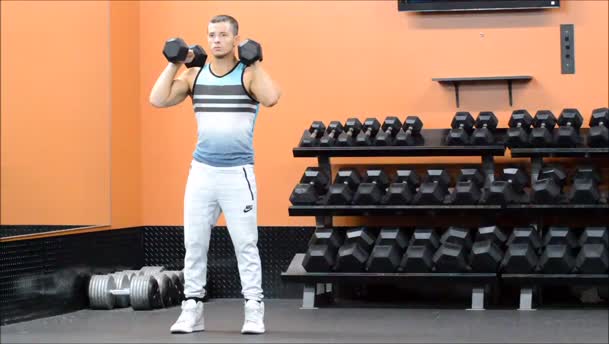
The quadriceps on the front of your thighs and your glutes do most of the work in squats. Front squats can be effectively performed by holding the dumbbells on your shoulders and squatting down.
Front Squats (Quadriceps and Glutes)
Together with the moves in the next section, these exercises cover your chest, back, shoulders, legs, arms and core. Next, we’ll explore specific dumbbell exercises that utilize your available equipment to optimally target these areas.
2. Optimal Dumbbell Workouts: Identifying the Most Effective Routines for Muscle Growth
The best full-body workout plan should target all the major muscle groups: chest, back, legs, and arms.
This section adds the Shoulder Press, Deadlifts and Back Lunges, plus two moves from the plan: Hammer Curls for your arms and the High Plank for your core.
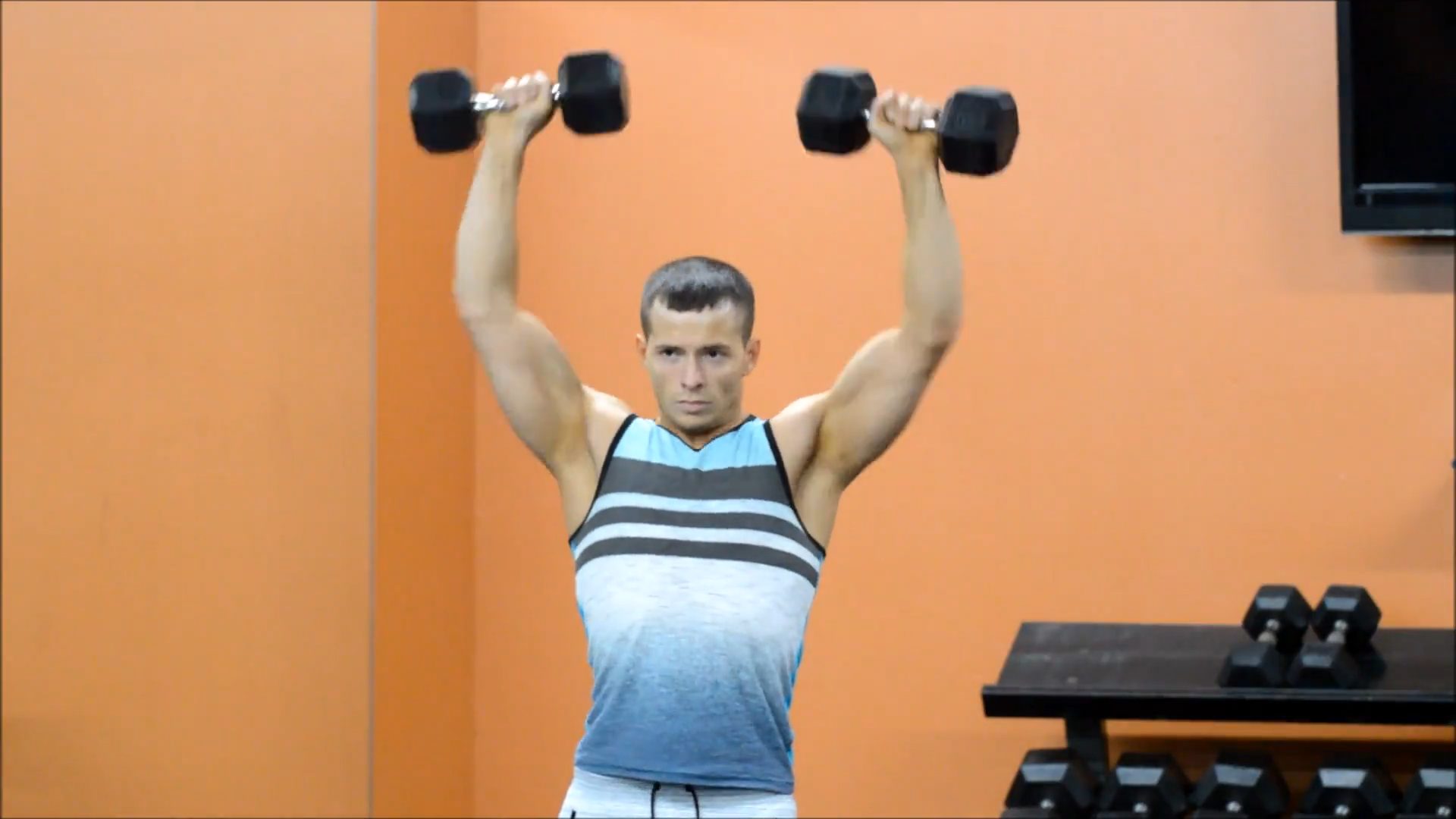
Shoulder Press – Shoulder Overload
How to Perform Shoulder Press
- Prepare Your Position: Stand with feet hip-width apart, dumbbells at shoulder height, palms facing forward.
- Execute the Standing Shoulder Press: Press the dumbbells upward until your arms are fully extended overhead.
- Controlled Return: Lower the dumbbells back to shoulder height.
- Repeat: Aim for 8-12 reps for hypertrophy/strength or 12-16 reps for endurance/hypertrophy.
Deadlifts – Lower Body Overload
How to Perform Deadlifts
- Prepare Your Position: Stand with feet hip-width apart, holding dumbbells in front of your thighs.
- Execute the Movement: Hinge at the hips and knees, lowering the dumbbells towards the ground while keeping your back straight.
- Controlled Return: Push through your heels to return to the standing position, ensuring your back remains neutral.
- Repeat: Do 8-12 repetitions per set, as in the plan above.
Back Lunges – Leg Overload
How to Perform Back Lunges
- Prepare Your Position: Stand with feet hip-width apart, holding dumbbells at your sides.
- Execute the Movement: Step one foot back into a lunge, ensuring the front knee aligns with the ankle.
- Controlled Return: Push through the front heel to return to the starting position.
- Repeat: Alternate legs, doing 8-12 repetitions per leg, as in the plan above.
Hammer Curls (Biceps and Forearms)
How to Perform Hammer Curls
- Prepare Your Position: Stand tall with a dumbbell in each hand at your sides, palms facing your body.
- Execute the Movement: Keeping your elbows close to your sides, curl both dumbbells up toward your shoulders, with your palms still facing each other.
- Controlled Return: Lower the dumbbells slowly until your arms are straight again.
High Plank (Core)
How to Perform the High Plank
- Prepare Your Position: Place your hands on the floor directly under your shoulders and step your feet back onto your toes, as if at the top of a push-up.
- Hold: Keep your body in a straight line from your head to your heels, without letting your hips sag or lift. Breathe steadily, and end the hold while your body is still straight, before your hips start to sag.
Remember, developing a strong and well-defined body involves more than just targeting the main muscle groups. It’s a good idea to work your muscles through their full range of motion. Adding reps or weight over time, as the plan above does, helps you keep progressing.
Try out the exercises in this section, and you’ll be ready to use them in the 4-week plan above.
If you’re looking for a comprehensive strength training regimen to enhance muscle definition and strength across all muscle groups, explore our LifeBuddy Apps to find the perfect program tailored to your goals and the equipment you have available.
3. Exercise Videos and Related Guides
Every exercise in this guide has its own page in our free exercise library, with a video demonstration, step-by-step form tips, common mistakes to avoid and the muscles it works:
- Dumbbell Press
- Alternating Rows
- Front Squats
- Shoulder Press
- Deadlifts
- Back Lunges
- Hammer Curls
- High Plank
Browse more in our total body exercises, chest exercises, back exercises and leg exercises lists.
Related guides: full body workouts, a full body workout plan, a dumbbell leg workout and a dumbbell chest workout.
Want a ready-made plan? Dumbbell Home Workout builds dumbbell workouts for every muscle group around your goal, level and schedule.
Full Body Dumbbell Workouts FAQ
Light enough that you can do every rep with the same form as in the videos, and heavy enough that the last few reps are hard. From week 2, pick a weight that lets you finish your reps with about 2 or 3 more left in you, an effort the American College of Sports Medicine says is enough (ACSM 2026). If you can’t do 8 good reps, go lighter; once you can do 12 good reps on every set with 2 or 3 to spare, go heavier next time, as the progression rule explains.
Yes. The Print this plan button at the top of the 4-week plan prints just the plan: the schedule, both workouts, the progression rule and the weight tips. In most browsers you can also choose Save as PDF in the print window to keep a copy. It’s free, with no sign-up.
Start the 4 weeks again, going a little lighter than your week 3 weights in week 1, and keep following the progression rule from week 2 so the workouts keep getting a little harder. After about 6 months of steady training, you can add sets or a fourth workout day: the American College of Sports Medicine suggests 3 to 4 days a week at that stage (ACSM 2009), and more weekly sets built more muscle in its 2026 review (ACSM 2026). You can also swap in other moves from our free exercise library, as long as each workout still works your legs, a push, a pull and your core. Or let the Dumbbell Home Workout app build your next plan around your goal, level and schedule.
Do 2 or 3 full-body sessions a week, like the 4-week plan above. In each, include one exercise for your legs, a push, a pull and a core move, for 2 to 3 sets of 8 to 12 reps, and add reps or weight as it gets easier. The Dumbbell Home Workout app builds this kind of plan around your level and schedule.
Two or three. A review of training studies found that working each muscle at least twice a week built more muscle than once a week (Schoenfeld 2016, in the references below), which a full-body plan does naturally. A 2026 review of the research adds that when the total number of weekly sets is the same, how often you train doesn’t seem to change muscle growth (ACSM 2026, in the references below). Back-to-back days can work too: one study found similar gains from training on consecutive or non-consecutive days (Yang 2018, in the references below).
For major full-body gains with minimal equipment, these exercises are top choices:
- Shoulder Press – Excellent for the shoulders and overall upper body strength.
- Deadlifts – Works your glutes, quads and lower back, with help from your hamstrings.
- Back Lunges – Great for leg strength and stability.
- Rows – Ideal for targeting the back muscles.
Train all the major muscle groups in each workout: chest, back, legs, shoulders and arms. Use dumbbells heavy enough that the last few reps of each set are hard, work through your full range of motion, and add reps or weight as you get stronger. It’s advisable to train your whole body 2-3 times per week, integrating both strength and hypertrophy workouts from LifeBuddy’s mobile apps.
REFERENCES
Yang Y, Bay PB, Wang YR, Huang J, Teo HWJ, Goh J. Effects of Consecutive Versus Non-consecutive Days of Resistance Training on Strength, Body Composition, and Red Blood Cells. Front Physiol. 2018 Jun 18;9:725.
Grgic J, Schoenfeld BJ, Davies TB, Lazinica B, Krieger JW, Pedisic Z. Effect of Resistance Training Frequency on Gains in Muscular Strength: A Systematic Review and Meta-Analysis. Sports Med. 2018 May;48(5):1207-1220.
American College of Sports Medicine. American College of Sports Medicine position stand. Progression models in resistance training for healthy adults. Med Sci Sports Exerc. 2009 Mar;41(3):687-708.
Currier BS, D’Souza AC, Singh MAF, Lowisz CV, Rawson ES, Schoenfeld BJ, Smith-Ryan AE, Steen JP, Thomas GA, Triplett NT, Washington TA, Werner TJ, Phillips SM. American College of Sports Medicine Position Stand. Resistance Training Prescription for Muscle Function, Hypertrophy, and Physical Performance in Healthy Adults: An Overview of Reviews. Med Sci Sports Exerc. 2026 Apr 1;58(4):851-872.
Piercy KL, Troiano RP, Ballard RM, Carlson SA, Fulton JE, Galuska DA, George SM, Olson RD. The Physical Activity Guidelines for Americans. JAMA. 2018 Nov 20;320(19):2020-2028.
Rogerson D, Nolan D, Androulakis Korakakis P, Immonen V, Wolf M, Bell L. Deloading Practices in Strength and Physique Sports: A Cross-sectional Survey. Sports Med Open. 2024 Mar 18;10(1):26.
Pancar Z, Ilhan MT, Darendeli MK, Karaca B, Ikidag MA, Tasdogan AM, Ulema MS, Alkhamees NH, Al-Mhanna SB, Batrakoulis A. Effects of deload periods in resistance training on muscle hypertrophy and strength endurance in untrained young men using a randomized within subject design. Sci Rep. 2026 Feb 24;16(1):10299.
Try LifeBuddy's free workout apps
- Dumbbell Home Workout: build muscle at home with dumbbells
- Weight Loss Workout At Home: no-equipment workouts to lose weight
- Pilates Workout at Home: beginner-friendly mat and Wall Pilates