
Exercises to Lose Belly Fat
(10 BEGINNER EXERCISES AND A WEEKLY PLAN TO LOSE BELLY FAT AT HOME)
Exercises to Lose Belly Fat
The best exercises to lose belly fat are ones that raise your heart rate and work your large muscles, done on most days of the week: brisk cardio such as marching, high knees and modified jumping jacks, plus strength moves such as squats and push-ups. No exercise burns fat from your belly alone, so crunches on their own won’t flatten your stomach. But regular exercise can lower your body fat overall, including the fat on your belly and the deeper fat around your organs.
This guide gives you 10 beginner-friendly exercises you can do at home with no equipment, each with a video demo, plus a simple weekly plan and a plain summary of what research says about exercise and belly fat. If you have a health condition or haven’t been active for a while, check with your doctor before you start.
Exercises to Lose Belly Fat
1. Can You Lose Belly Fat With Exercise?
2. 10 Exercises to Lose Belly Fat at Home
3. A Simple Weekly Plan for Beginners
4. Food and Sleep Matter Too
5. How to Track Belly Fat Loss
6. Exercise Videos and Related Guides
1. Can You Lose Belly Fat With Exercise?
Yes, but not from your belly alone. Exercise can help you lose fat all over your body, and your belly is part of that.
Belly fat comes in two kinds. Subcutaneous fat sits just under your skin: it’s the fat you can pinch. Visceral fat lies deeper, around your organs, and a large research review describes it as a stronger predictor of illness and death than body weight (Verheggen 2016). Regular exercise can reduce both, as part of whole-body fat loss.
What exercise can’t reliably do is choose where the fat comes off. In the two studies below that trained only the abs or only one leg, the trained area lost no extra fat (see the table). One small 2023 trial did find some extra trunk-fat loss when ab exercises were added to running, with similar total fat loss (see the FAQ on crunches). So the goal is to lower your overall body fat, which includes your belly fat.
What the main studies found (each study name links to its summary on PubMed):
| Study | Who took part and what they did | What happened |
|---|---|---|
| Vispute 2011 | 24 inactive adults: 7 ab exercises (2 sets of 10 reps) 5 days a week for 6 weeks, or no exercise | No significant change in belly fat, waist size or body fat percentage. The ab group could do more curl-ups at the end (47 vs 32). |
| Ramírez-Campillo 2013 | 11 young adults: light leg presses with one leg only, 960 to 1,200 reps a session, 3 times a week for 12 weeks | Body fat mass fell 5.1%, with significant drops in the arms (10.2%) and trunk (6.9%), but no significant change in the trained leg. |
| Vissers 2013 | Review of 15 studies (852 people): exercise programs for overweight adults, without a calorie-cutting diet | Exercise reduced visceral fat. Moderate- or high-intensity aerobic exercise had the most potential to reduce it. |
| Verheggen 2016 | Review of 117 studies (4,815 people): exercise compared with dieting | Dieting caused more weight loss; exercise tended to cut more visceral fat. Without weight loss, exercise was linked to a 6.1% drop in visceral fat (diet: 1.1%). |
| Wewege 2017 | Review of 13 trials in overweight and obese adults aged 18 to 45, training 3 times a week for 10 weeks on average | High-intensity interval training (HIIT) and moderate cardio both reduced fat mass and waist size, with no significant difference. HIIT took about 40% less time. |
| Wewege 2022 | Review pooling 54 trials in healthy adults: full-body strength training for at least 4 weeks, compared with no exercise | Strength training reduced body fat percentage by 1.46 points, fat mass by 0.55 kg, and visceral fat. |
What this means for you:
- Do cardio and strength exercises. A review of 35 trials found that aerobic exercise reduced visceral fat, while the effect of strength training alone was not significant, and its authors suggest that aerobic exercise is central to exercise programs aimed at reducing visceral fat (Ismail 2012). A later review in healthy adults found that strength training reduced body fat and visceral fat too (Wewege 2022), and the NHS recommends strengthening activities on at least 2 days a week (NHS).
- Pick an intensity you can keep up. Interval training and steady cardio reduced fat by similar amounts; intervals just took less time (Wewege 2017).
- Don’t judge by the scale alone. Weight loss may be a poor marker of visceral fat loss (Verheggen 2016), so measure your waist too (see section 5).
2. 10 Exercises to Lose Belly Fat at Home
These 10 no-equipment moves suit beginners. The first six are standing cardio moves with no jumping, the next three build strength, and the last one combines both.
None of them burns belly fat by itself. Done regularly, together, they can help you lose fat all over. Tap a video to play it, start with the easier option if a move feels too hard, and stop any move that causes pain.
1. March in Place
How to Perform March in Place
- Prepare Your Position: Stand tall with your feet hip-width apart and your arms relaxed at your sides.
- Execute the Movement: Lift one knee to a comfortable height, lower it and lift the other knee, as if you were marching.
- Repeat: Keep a brisk, steady rhythm for the whole interval, with your core lightly braced.
- Make It Easier or Harder: March slowly to make it easier. Lift your knees higher and speed up to make it harder.
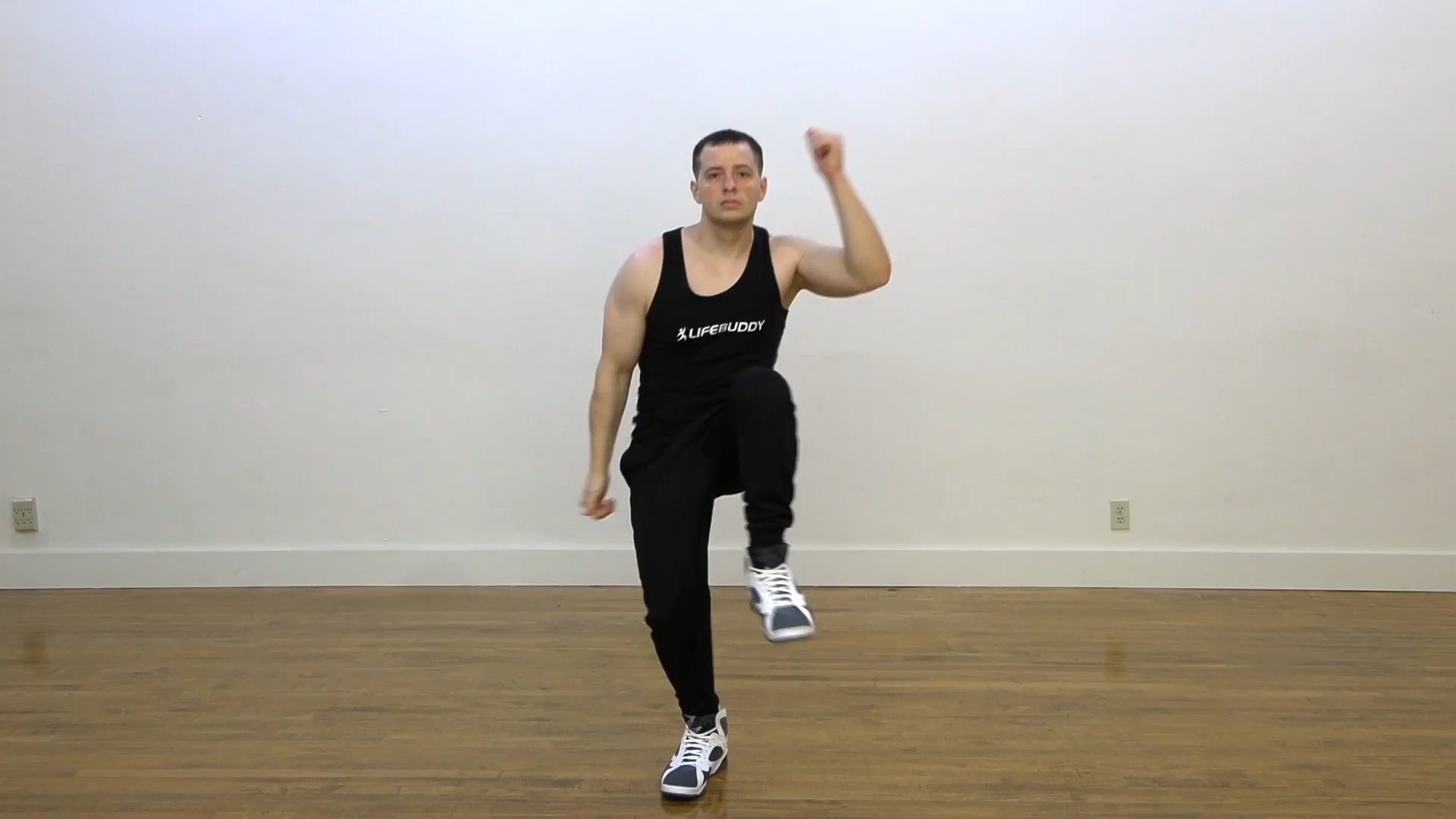
2. Walking High Knees
How to Perform Walking High Knees
- Prepare Your Position: Stand tall with your heels close together and your toes turned slightly out.
- Execute the Movement: Lift one knee to about hip height as you raise the opposite arm, elbow bent and hand up.
- Repeat: Lower both and switch sides in a quick rhythm. Stay tall and don’t lean back.
- Make It Easier or Harder: Lift your knees lower and slow down to make it easier. Speed up to make it harder.
3. March & Clap
How to Perform March & Clap
- Prepare Your Position: Stand with your feet hip-width apart and your arms out to your sides.
- Execute the Movement: Lift one knee toward hip height and clap your hands together under your thigh.
- Repeat: Lower your leg as your arms open back out to your sides, then lift the other knee and clap again.
- Make It Easier or Harder: Lift your knee only as high as feels comfortable to make it easier. Go faster to make it harder.
4. Modified Jumping Jack
How to Perform a Modified Jumping Jack
- Prepare Your Position: Stand with your feet close together and your arms by your sides.
- Execute the Movement: Lift one leg out to the side, with a slight bend in the knee, as you raise both arms overhead.
- Repeat: Lower your leg and arms back to the start, then lift the other leg. Keep alternating.
- Make It Easier or Harder: Lift your leg only a little, or just tap your foot out to the side, and move more slowly to make it easier. Speed up to make it harder, or switch to regular jumping jacks once jumping feels comfortable.
5. Pivoting Upper Cuts
How to Perform Pivoting Upper Cuts
- Prepare Your Position: Stand with your feet wider than shoulder-width, knees slightly bent and your fists up in front of your chest.
- Execute the Movement: Twist your hips and chest to one side, pivoting on the ball of one foot, and throw a short uppercut as you turn.
- Repeat: Twist back the other way and throw an uppercut with the other hand, in a smooth rhythm.
- Make It Easier or Harder: Turn less and slow down to make it easier. Bend your knees a little as you turn and speed up to make it harder.
6. Standing Mountain Climbers
How to Perform Standing Mountain Climbers
- Prepare Your Position: Stand with your feet hip-width apart and a slight bend in your knees.
- Execute the Movement: Drive one knee up as you raise the arm on the same side, elbow bent and pointing out, fist up. Keep your other arm low.
- Repeat: Switch sides in a steady climbing rhythm, keeping your back straight without leaning back.
- Make It Easier or Harder: Slow down to make it easier. Speed up, or try mountain climbers on the floor, to make it harder.
7. Air Squat
How to Perform an Air Squat
- Prepare Your Position: Stand with your feet slightly wider than shoulder-width, toes turned slightly out, and your hands together in front of your chest.
- Execute the Movement: Push your hips back and bend your knees until your thighs are about parallel to the floor, or as low as feels comfortable. Keep your chest up and your knees in line with your toes.
- Repeat: Press through your heels to stand back up, and repeat at a slow, controlled pace.
- Make It Easier or Harder: Squat down to a chair, touch it lightly and stand back up (chair squats) to make it easier. Pause for 2 seconds at the bottom to make it harder.
8. Wall Push-Up
How to Perform a Wall Push-Up
- Prepare Your Position: Stand facing a wall, a little more than arm’s length away, and place your hands flat on it at shoulder height, slightly wider than your shoulders.
- Execute the Movement: Keeping your body straight from head to heels, bend your elbows to bring your chest toward the wall.
- Repeat: Push back to the start and repeat at a slow, steady pace.
- Make It Easier or Harder: Stand closer to the wall to make it easier. Step your feet farther back to make it harder, and later try push-ups with your hands on a sturdy chair.
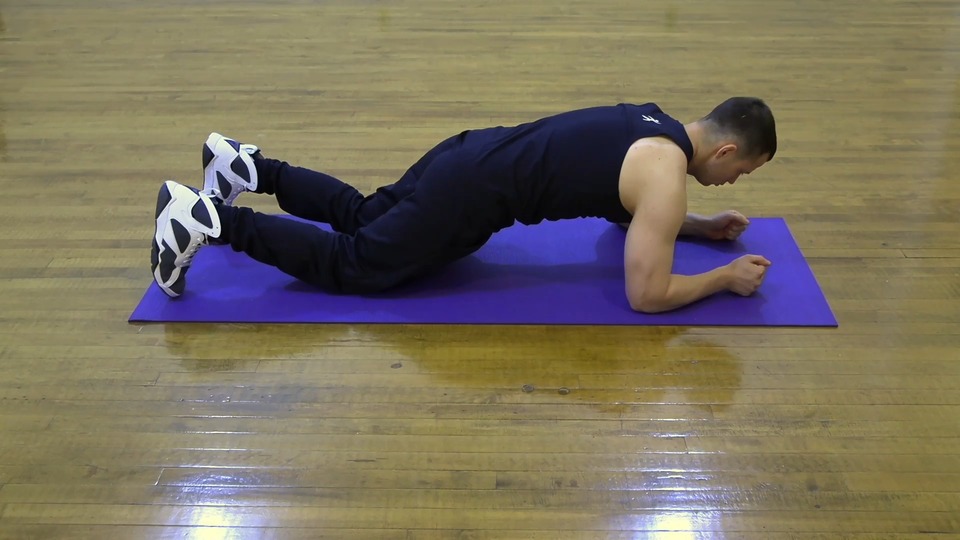
9. Knees-On-Ground Plank Hold
How to Perform a Knees-On-Ground Plank Hold
- Prepare Your Position: Rest on your forearms with your elbows under your shoulders and your knees on the floor, feet lifted.
- Execute the Movement: Brace your stomach and squeeze your glutes so your body forms a straight line from your head to your knees.
- Repeat: Hold still and breathe steadily for the interval, then rest and hold again.
- Make It Easier or Harder: Hold for less time to make it easier. Straighten your legs into a full plank to make it harder (see our planks for beginners guide).
10. Beginner Burpees
How to Perform Beginner Burpees
- Prepare Your Position: Stand with your feet shoulder-width apart.
- Execute the Movement: Bend your knees, hinge at your hips and place your hands on the floor in front of your feet. Walk your hands forward into a high plank and do one push-up.
- Repeat: Walk your hands back to your feet, stand up tall and repeat at a steady pace.
- Make It Easier or Harder: Skip the push-up, or walk your hands out only partway, to make it easier. Step your feet back into the plank instead of walking your hands out, and add a small jump at the top, to make it harder.
3. A Simple Weekly Plan for Beginners
Aim for at least 150 minutes of moderate activity a week, or 75 minutes of vigorous activity, plus strength exercises on at least 2 days. That’s what the NHS and the CDC recommend for adults (NHS; CDC).
Moderate means you’re working hard enough that you can still talk, but not sing (NHS). Here is one way to fit it into a week:
- Monday, Wednesday and Friday: the circuit below, about 30 minutes.
- Tuesday, Thursday and Saturday: a brisk walk, outside or with our walking workout at home. Start with what feels comfortable and build up to 40 minutes.
- Sunday: rest, or an easy walk.
The circuit: Warm up with 3 minutes of marching in place. Then do each of the 10 exercises above for 30 seconds, resting for 30 seconds before the next one. That’s one 10-minute round. Do 2 rounds, then cool down with a few minutes of easy walking and gentle stretching.
Make it harder every 2 weeks or so: add a third round, work for 40 seconds and rest for 20, or switch to the harder options. When you’re ready for more, try our 20-minute HIIT workout at home, or keep the impact low with low impact cardio at home.
4. Food and Sleep Matter Too
A few everyday habits support what you do in your workouts.
- Eat a little less. In a review of 117 studies, both dieting and exercise reduced visceral fat: dieting led to more weight loss, while exercise tended to cut more visceral fat (Verheggen 2016). So it makes sense to do both.
- Protect your sleep. Ten overweight adults followed a reduced-calorie diet for 14 days twice: once with 8.5 hours a night allowed for sleep and once with 5.5. With less sleep, they lost less fat (0.6 kg vs 1.4 kg) and more fat-free mass (2.4 kg vs 1.5 kg) (Nedeltcheva 2010). It was a small, short study, but it’s a good reason not to cut your sleep short while you’re trying to lose fat.
- Sit less. The NHS also advises adults to reduce time spent sitting or lying down and to break up long periods of not moving with some activity (NHS). For example, get up for a short walk or a few minutes of marching in place.
5. How to Track Belly Fat Loss
Measure your waist, not just your weight.
Your weight may not reflect how much visceral fat you’ve lost (Verheggen 2016), so use a tape measure too. Measure your waist once a week, at the same spot and the same time of day. The NHS suggests keeping your waist size to less than half your height (NHS). For example, if you’re 170 cm (5 ft 7 in) tall, that means a waist under 85 cm (33.5 in).
Other signs of progress count too: clothes that fit more loosely, and workouts that feel easier, so you can add a round or try the harder options.
6. Exercise Videos and Related Guides
Every exercise in this guide has its own page in our free exercise library, with a video demonstration, step-by-step form tips, common mistakes to avoid and the muscles it works:
- March in Place
- Walking High Knees
- March & Clap
- Modified Jumping Jack
- Pivoting Upper Cuts
- Standing Mountain Climbers
- Air Squat
- Wall Push-Up
- Knees-On-Ground Plank Hold
- Beginner Burpees
Browse more in our cardio exercises and HIIT exercises lists.
Related guides: lower belly fat exercises, how to lose upper belly fat, waist slimming exercises and a home workout for weight loss.
Want a ready-made plan? Weight Loss Workout At Home builds no-equipment workouts around your goal, level and training days.
BELLY FAT EXERCISES FAQ
There isn’t a single best one. A review of 35 trials suggests that aerobic exercise (cardio) is central to exercise programs aimed at reducing visceral fat (Ismail 2012), and strength training lowers body fat too (Wewege 2022), so a mix of both makes sense. For beginners at home, brisk cardio such as Walking High Knees or March & Clap, plus squats and wall push-ups, is a good start. The best exercise is the one you’ll keep doing week after week.
Not by themselves. In a 6-week study, adults who did 7 ab exercises 5 days a week could do more curl-ups at the end, but their belly fat and waist size didn’t change significantly compared with people who didn’t exercise (Vispute 2011). One small 2023 trial in 16 overweight men found about 0.7 kg (1.5 lb) more trunk fat loss when weighted crunches and torso rotations were added to a shorter treadmill run, compared with running alone, but total fat loss was similar in both groups (Brobakken 2023). Ab exercises make your core stronger, but the best-supported way to lose belly fat is to lower your body fat overall.
Yes, it can help. Brisk walking is a moderate-intensity activity (NHS), and a review of 15 studies found that moderate- or high-intensity aerobic exercise had the most potential to reduce visceral fat (Vissers 2013). Walk fast enough that you can talk but not sing. On bad-weather days, try our walking workout at home.
Not clearly. A review of 13 trials in overweight and obese adults found that high-intensity interval training (HIIT) and steady, moderate cardio both reduced whole-body fat and waist size, with no significant difference between them, but HIIT took about 40% less training time (Wewege 2017). Choose the one you’ll stick with. When you’re ready for intervals, try our 20-minute HIIT workout at home.
It varies from person to person, so no plan can promise a date. Studies have measured changes within a few months: in one review, trials lasting 10 weeks on average reduced fat mass and waist size (Wewege 2017), and another review suggests that an aerobic exercise program can reduce visceral fat even after 12 weeks (Vissers 2013). Stick with your plan for at least 3 months, and measure your waist once a week to see how it’s going.
Start with the weekly amounts the NHS recommends for adults: at least 150 minutes of moderate activity or 75 minutes of vigorous activity, spread over 4 to 5 days or every day, plus strengthening activities on at least 2 days (NHS). Once your walks reach 40 minutes, the plan in this guide gets you there: the 3 brisk walks add up to 120 minutes, the warm-ups and cardio moves in the 3 circuits add about 30 more, and the squats, wall push-ups and planks are your strength exercises.
It helps. A review of 117 studies found that both dieting and exercise reduced visceral fat. Dieting led to more weight loss, while exercise tended to cut more visceral fat, and even without weight loss, exercise was linked to a 6.1% drop in visceral fat (Verheggen 2016). So it makes sense to combine the two.
REFERENCES
Ramírez-Campillo R, Andrade DC, Campos-Jara C, Henríquez-Olguín C, Alvarez-Lepín C, Izquierdo M. Regional fat changes induced by localized muscle endurance resistance training. J Strength Cond Res. 2013 Aug;27(8):2219-24.
Brobakken MF, Krogsaeter I, Helgerud J, Wang E, Hoff J. Abdominal aerobic endurance exercise reveals spot reduction exists: A randomized controlled trial. Physiol Rep. 2023 Nov;11(22):e15853.
Vissers D, Hens W, Taeymans J, Baeyens JP, Poortmans J, Van Gaal L. The effect of exercise on visceral adipose tissue in overweight adults: a systematic review and meta-analysis. PLoS One. 2013;8(2):e56415.
Verheggen RJ, Maessen MF, Green DJ, Hermus AR, Hopman MT, Thijssen DH. A systematic review and meta-analysis on the effects of exercise training versus hypocaloric diet: distinct effects on body weight and visceral adipose tissue. Obes Rev. 2016 Aug;17(8):664-90.
Ismail I, Keating SE, Baker MK, Johnson NA. A systematic review and meta-analysis of the effect of aerobic vs. resistance exercise training on visceral fat. Obes Rev. 2012 Jan;13(1):68-91.
Wewege M, van den Berg R, Ward RE, Keech A. The effects of high-intensity interval training vs. moderate-intensity continuous training on body composition in overweight and obese adults: a systematic review and meta-analysis. Obes Rev. 2017 Jun;18(6):635-646.
Wewege MA, Desai I, Honey C, Coorie B, Jones MD, Clifford BK, Leake HB, Hagstrom AD. The Effect of Resistance Training in Healthy Adults on Body Fat Percentage, Fat Mass and Visceral Fat: A Systematic Review and Meta-Analysis. Sports Med. 2022 Feb;52(2):287-300.
Nedeltcheva AV, Kilkus JM, Imperial J, Schoeller DA, Penev PD. Insufficient sleep undermines dietary efforts to reduce adiposity. Ann Intern Med. 2010 Oct 5;153(7):435-41.
NHS. Physical activity guidelines for adults aged 19 to 64. Page last reviewed 22 May 2024.
NHS. Overweight and obesity in adults. Page last reviewed 29 April 2026.
Centers for Disease Control and Prevention. Adult Activity: An Overview. December 20, 2023.
Try LifeBuddy's free workout apps
- Dumbbell Home Workout: build muscle at home with dumbbells
- Weight Loss Workout At Home: no-equipment workouts to lose weight
- Pilates Workout at Home: beginner-friendly mat and Wall Pilates